
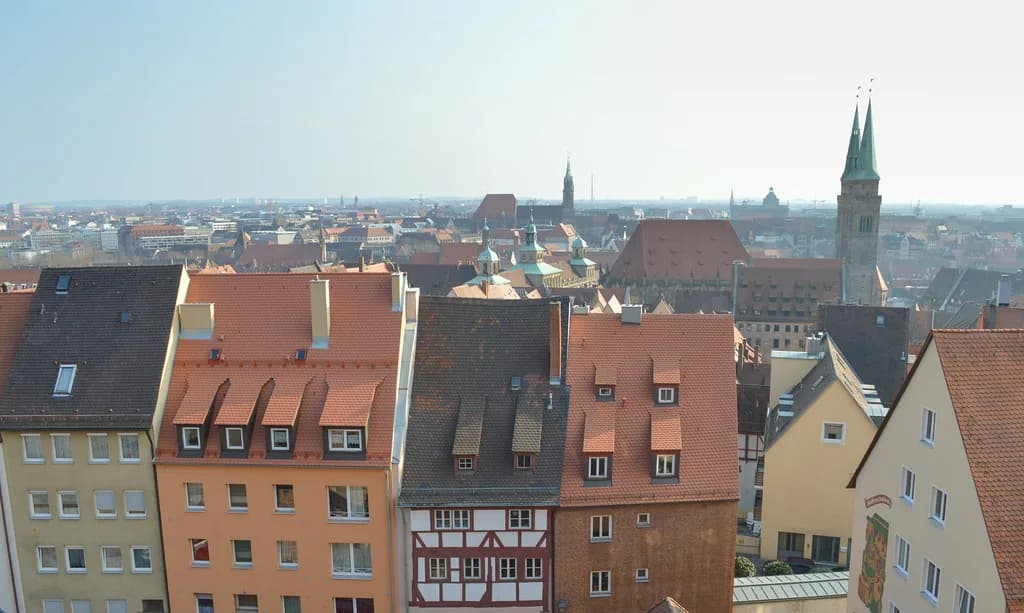
Most visitors treat the Imperial Castle as the single answer to the Nuremberg viewpoints question, then discover that the complex works on several levels at once. The outer areas, terraces and gardens sit on the sandstone hill above the Old Town and can be walked without buying anything, while the interiors and the Sinwell Tower carry separate admission. Deciding whether you want a rooftop panorama, a market-square angle or a free walk with a view determines which part of the hill you actually need.
The city's geography does most of the work here. The Altstadt sits on the Pegnitz, the castle hill rises along its northern edge, and the Hauptmarkt anchors the pedestrian core just below. Because almost every elevated viewpoint is on that northern side, a sensible route drifts downhill from the castle toward the river rather than zigzagging back up.
The Geography That Decides Which View You Get
Nuremberg spreads across a river valley with a sandstone ridge on its northern flank, and the medieval core is wrapped by walls that are among the longest still standing in Europe. Germany's national tourist board describes a skyline still dominated by the fortress begun around 1140 under Emperor Konrad III, with the historical mile running past decorated churches and fountains from the castle end. That single sentence explains why the castle hill keeps coming up: it is both the oldest and the highest thing in the picture.
Practically, this means your choice is between three elevations rather than three attractions. The castle plateau gives the wide panorama over roofs, spires and the Pegnitz; the church towers drop you closer to the market and the shopping streets; and street level still frames a great deal, because the Old Town's pedestrian zone is unusually large and the bridges over the river compose views without any climb at all.
The Walk Up to the Imperial Castle: Free Where It Matters
The climb to the castle is free, and so is a substantial part of what you find at the top. Visitors can walk the surroundings and the castle gardens without paying, and the ascent is not especially hard even though the hill is steep enough to feel like a real climb. Several vantage points along the way look out over Nuremberg's rooftops and church spires, which is why the grounds alone satisfy plenty of people.
Treat the castle as a chain of separate buildings and towers on a hill rather than one grand palace with a single entrance. That framing matters because it stops you from assuming that reaching the top and buying a ticket are the same decision. If your goal is the view rather than the interiors, you can reach the plateau, look out and leave without spending anything.
Once you have had enough of the hill, the descent into the northern Old Town is part of the experience. Weißgerbergasse and the streets just below the castle keep the half-timbered character that makes street-level photography worthwhile even on days when the light up top is poor.
What Is Free and What Is Ticketed at the Castle
The most useful thing to understand before you climb is that open grounds and ticketed interiors are separate purchases, not one package. The outer areas and gardens are accessible without a ticket, while the interior spaces and the Sinwell Tower are entered for a fee or with the Nürnberg Card according to the organiser's published information. Do not assume one ticket covers every building and collection in the complex, because the castle's different parts are administered and priced individually.
Because admission arrangements and opening periods change, check the ticket scope on the organiser's own pages before you travel rather than relying on older trip reports. What you want to confirm is straightforward: which interiors a given ticket admits you to, whether the tower is included or sold separately, and whether any part of the complex is closed for works. Prices found in old blog posts are not reliable for a 2026 visit.
Climbing the Sinwell Tower: Height Is a Trade-Off
The Sinwell Tower is the tall, cylindrical structure that gives the castle its most photographed silhouette, and climbing it produces the higher, more sweeping view over the Old Town. The climb is the point as much as the view, and it is the sort of stop that rewards people who enjoy the effort itself. If stairs in a confined space are unpleasant for you, the free terraces still deliver a good panorama without the exertion.
The honest trade-off is that more height does not automatically give a better photograph. A tower position compresses the city into a wide, flat carpet of roofs, while the lower terraces and gardens let you include the castle's own walls and towers in the frame. Many visitors shoot both and prefer the second. Treat the tower as an optional add-on rather than the reason for the trip.
The Castle Gardens: The Low-Effort Panorama
For anyone who cannot manage stairs, or simply does not want to, the castle gardens are the best-value answer in the city. They sit within the free part of the complex and look out across the rooftops without any climbing beyond the hill itself. Walking down from them along the line of the old walls toward the town is a gentle way to combine the view with a quiet stretch away from the busiest courtyards.
If mobility is a deciding factor, treat the whole hill as something to verify rather than assume. Gradients, cobbles and the surfaces of individual paths vary, and rules on step-free routes, lifts and assistance can change. Contact the castle operator directly before you go and describe what you need, because published accessibility guidance is more reliable than any general impression that the site is or is not manageable.
Church Tower Tours: A Lower Vantage Point Over the Market
The towers of St. Sebaldus and St. Lorenz give a different picture from the castle, closer to the market square and the pedestrian streets, with the rooftops of the Altstadt filling the frame. Entering both churches is free, but the tower climbs are organized separately as paid tours that are usually arranged in advance. The two churches are a short walk apart and each is beautiful in its own right, so the interior alone justifies a stop even if the tower does not work out.
The tower tours are the weakest thing to plan around, because they are conditional. Availability depends on the season, staff and the day, and a single operator page cannot be assumed to describe the current week. Confirm dates, times, group sizes and the physical demands of the climb with the church or the tour operator before you build a day around one.
While you are inside St. Sebaldus, the bronze shrine of the city's patron saint is worth a deliberate look rather than a glance on the way through. The tomb of St. Sebaldus is a Renaissance work made between 1508 and 1519, a joint production by Peter Vischer the Elder and his sons, and it survives in the church where it was installed. It gives a quiet, interior counterpoint to the outdoor viewpoints on this list.
Free Viewpoints and Street-Level Frames
Not every good view involves altitude, and Nuremberg's free angles are scattered through the Old Town. Tiergärtnertorplatz, right below the castle gate and beside Albrecht Dürer's house, is a natural pause on the way down, and the bridges over the Pegnitz, including the Henkersteg and the Maxbrücke area, compose the classic image of towers and red roofs above the water. The pedestrian streets around the Hauptmarkt frame spires and facades at every turn.
Germany's national tourist board uses a photograph of Tiergärtnertorplatz to introduce the city, which is a fair indication of how strongly that square reads as a postcard. Beyond the square, the riverside quarter and the surviving stretches of wall give you elevation of a different kind: you are looking along the walls and across the water rather than down on the city.
If you want to maximize free views in a single loop, start at the Hauptmarkt, walk up to the castle, drop to Tiergärtnertorplatz, then follow the streets down to the Pegnitz and cross at the bridges. That route uses the hill once, in one direction, and ends among the best street-level compositions in the city.
Do You Need a City Pass for the Viewpoints?
The Nürnberg Card is worth considering only if you plan to stack several paid interiors on the same day, because its value comes from accumulation rather than from any single stop. The card is marketed around free entry to a long list of museums and attractions plus public transport in Nuremberg, Fürth and Stein, and the operator publishes the current list of participants on its own site. What it does not do is turn the free castle grounds into anything better than free.
Whether a card includes a specific tower or view depends on the operator and the period, so verify rather than assume. Add up the individual admissions for the places you genuinely intend to enter, compare that figure with the card price on the day you travel, and only then decide. For a viewpoint-only visit built around the castle terraces and the river bridges, the honest answer is usually that you do not need a pass at all.
Timing Your Visit: Crowds and Light
The castle gets busiest once organized groups have cleared the breakfast hour, so the practical move is to climb early and come down as the coaches arrive. Mid-morning also clears the haze that lingers over the valley, which flattens distant rooftops on cloudy days. Afternoon brings warmer, lower light that suits photographs looking down over the Old Town, particularly toward the river and the market.
Season changes the light as much as the hour does. On a winter afternoon the sun drops behind the buildings early, while in summer the long evening makes the walk down from the castle toward the Pegnitz the most rewarding stretch of the day. Whatever you choose, check the day's actual opening information with the operators rather than relying on a remembered schedule, because seasonal hours are exactly the kind of detail that changes.
A Suggested Half-Day Viewpoint Route
Begin at the Hauptmarkt, where the Gothic Church of Our Lady and the Beautiful Fountain give you the market square's framing element before any climb. Walk north through the pedestrian streets and up to the castle hill. Allow roughly two to three hours for the whole loop at an unhurried pace, and treat that as a suggestion rather than an official figure, since the time you spend at each terrace is entirely personal.
At the top, decide in the moment whether the Sinwell Tower or the interiors are worth the admission to you, then continue down through Tiergärtnertorplatz and toward the river. If you are short on time, you can cut the route at the castle and return to the market the way you came; the hill is the essential stop, everything below it is a bonus.
If you have more than an afternoon, this walk works as the spine of a longer visit rather than a standalone excursion. A day-focused route is easy to extend into a full two- or three-day plan by adding the memorial sites and museums that sit outside the Old Town.
Plan Your Visit
Nuremberg's viewpoints split cleanly along a single line: what you can see for nothing from the castle grounds, gardens and terraces, and what you pay for inside the complex or up a tower. Decide which of those you actually want before you start walking uphill, and the hill stops being a confusing bundle of ticket desks.
Whatever you choose, confirm the day's arrangements directly with the castle operator and the churches rather than relying on old blog posts, whose admission details age quickly. Published opening hours, ticket scope and tower tour schedules are exactly the things that change from season to season, and a short check before you go saves a wasted climb.
Frequently Asked Questions
What are the best viewpoints in Nuremberg?
The strongest panoramas come from the castle hill on the northern edge of the Old Town, where the terraces, gardens and outer grounds look across the rooftops toward the Pegnitz and the church spires. The Sinwell Tower at the castle and the church tower tours at St. Sebaldus and St. Lorenz offer higher but differently framed views, closer to the market square and the pedestrian streets. Street level also counts: the bridges over the river and Tiergärtnertorplatz below the castle produce classic compositions without any climb at all.
Is the view from Nuremberg Castle free?
A substantial part of it is. Visitors can walk the castle surroundings and the gardens without paying, and those areas provide panoramic views over the Old Town from several vantage points. The interiors and the Sinwell Tower are ticketed separately, so treat the free grounds and the paid interiors as two different decisions rather than one entrance fee. Check the current ticket scope with the castle operator before you travel, because it is not safe to assume that one ticket covers every part of the complex.
Do I need a ticket to climb the Sinwell Tower?
Yes, the tower is part of the paid side of the castle rather than the free grounds, and admission arrangements can be purchased with a ticket or a city card depending on the operator's current rules. Because prices and inclusions change, verify the exact arrangement on the site's own pages rather than relying on older trip reports. Consider whether the extra height is worth the stairs to you; the free terraces and gardens already give a wide view of the city.
Are Nuremberg church tower tours worth it?
They give a genuinely different perspective from the castle because they sit lower and closer to the market and shopping streets, so the frame fills with rooftops rather than a distant carpet of buildings. Entering both St. Sebaldus and St. Lorenz is free, but the tower climbs are organized separately as paid tours and are conditional on the day. Confirm dates, times and the physical demands with the church or operator before you plan around one.
Where can I get good views in Nuremberg without climbing?
The castle gardens and the free areas around the complex are the obvious answer, since they sit on the hill and look out over the rooftops without requiring stairs beyond the walk up. At street level, the bridges over the Pegnitz and the squares below the castle, including Tiergärtnertorplatz, frame towers, half-timbered facades and the river. If stairs or gradients are a concern, contact the castle operator in advance and describe what you need, because path surfaces and access arrangements vary across the site.
What time of day is best for views over Nuremberg?
Early morning is the simplest answer for the castle, because the organized groups arrive later and the light is often clearer over the valley. Afternoon and early evening give warmer, lower light that suits photographs looking down over the Old Town toward the river. Opening hours and last admission change with the season, so check the current times with the operator rather than relying on a remembered schedule.
Sources
- 9 Instagram-mable spots & (free) things to do in Nuremberg - capturing the heritage of Germany
- Visit Nuremberg - Top sights and attractions - Germany Travel
- St. Sebaldus Tomb | Work of art | Virtual museum of Nuremberg art
- Nuremberg Old Town: a Local’s Guide | That’s What She Had
- Nuremberg Zoo - Congress- und Tourismus-Zentrale Nürnberg


