
Heidelberg's Altstadt is compact enough that its main landmarks sit within easy strolling distance of one another, with the castle view, the Neckar banks and the old town streets forming the backdrop to almost every turn. That density is why a walk works better than a checklist here: you can move from a market square to a church tower to a university courtyard without needing transport. This route is a suggestion for structuring that walk, not an official itinerary, and the pace is yours to set.
The route below links Marktplatz, the churches, university buildings and the Old Bridge, and it deliberately separates what is simply walkable at street level from interiors that are ticketed or in active use. A suggested duration of about an hour and a half on foot keeps the squares from feeling rushed, though slower walkers can shorten it without missing the essential sequence. For a fuller day that adds the castle and riverbank time, the Heidelberg one day itinerary can absorb this walk as its middle section.
Why the Altstadt Rewards a Walk Rather Than a Checklist
Heidelberg Marketing describes the city's heart as beating between the castle view, the banks of the Neckar and the old town streets, which is a fair summary of how tightly the historic core is packed. Picturesque alleys, landmarks and green retreats sit within a small area, so the pleasure comes from moving through them rather than ticking off separate stops. Walking also lets you notice the transitions: a quiet courtyard that opens onto a busy square, or a view of the river that appears without warning between buildings.
The old town is the oldest part of the city, and its layout rewards slow movement rather than a forced march between highlights. Because the main squares, church towers, university buildings and the river all lie within strolling distance, you can cover the core on foot without needing to plan transport between stops. The route below assumes you start near the market square and finish at the bridge, which keeps the river as a natural endpoint.
Know Before You Go: Free Streets Versus Paid Interiors
Walking the streets, squares and bridge is free, but several interiors along the way are working institutions with their own access rules, and some charge admission. Heidelberg Marketing publishes a public Altstadt walking tour, the Altstadtrundgang, which it lists with a duration of 1 hour 30 minutes, a meeting point at Neckarmünzplatz by the Tourist Information, and a starting price from 13,00 €. That listing covers a guided tour, not self-guided access, so do not read it as the cost of walking the route yourself.
Before setting out, check current guided-tour dates, access arrangements and any site notices with Heidelberg Marketing, since church interiors, university buildings and ticketed collections can change how they receive visitors. The distinction matters: a church may be open for worship but not for sightseeing at a given moment, and a university building may be in everyday use rather than open to the public. Treat any schedule you find online as something to verify on the day rather than a fixed promise.
Start at Marktplatz and Orienting Yourself
Marktplatz anchors the old town and is described by Heidelberg Marketing as one of Heidelberg's oldest squares, which makes it a sensible place to begin. Its edges are lined with buildings and cafés, and the square functions as a meeting point as much as a sight, so it is worth a slow circuit rather than a quick photo. From here you can see how the streets radiate outward toward the church, the university quarter and the river.
The Church of the Holy Spirit Heidelberg sits directly on the market square, so the two stops overlap naturally and you do not need to make a separate detour. Start by reading the square's shape and the surrounding facades, then turn your attention to the church exterior before deciding whether to step inside. This ordering keeps the walk flowing and prevents backtracking later.
Churches Along the Route: Working Places of Worship
The churches on this route are active places of worship first, which shapes what a visitor can reasonably expect. Exteriors, towers and churchyards can be appreciated from the street at any time, and the architecture often reads best from a few steps back rather than from directly below. Interiors depend on whether services, rehearsals or other activities are underway, so treat any open door as an invitation rather than a guarantee.
If you want to go inside the Heiliggeistkirche Heidelberg, keep your visit quiet and brief and avoid moving through the building during worship. It is reasonable to look for posted information at the entrance, but opening arrangements are not something to plan around in advance from a distance. If the doors are closed, the square outside still gives you the church's scale and its relationship to the market.
University Buildings in the Old Town
Heidelberg Marketing lists the Old University under the city's sights, describing it as moving from tradition into the future. That phrasing is a useful reminder that these are functioning university spaces, not museum exhibits. You can appreciate courtyards, facades and the general atmosphere of the university quarter from public areas, but teaching rooms, libraries and administrative offices are not tourist attractions.
Walk past rather than through: notice the buildings' proportions, the way the university interleaves with the surrounding streets, and how students and locals move through the same spaces. If a doorway is open and clearly marked for visitors, that is a signal; if it is not, stay outside. This keeps the walk respectful and avoids awkward encounters with people going about their day.
Down to the Old Bridge and the Neckar Bank
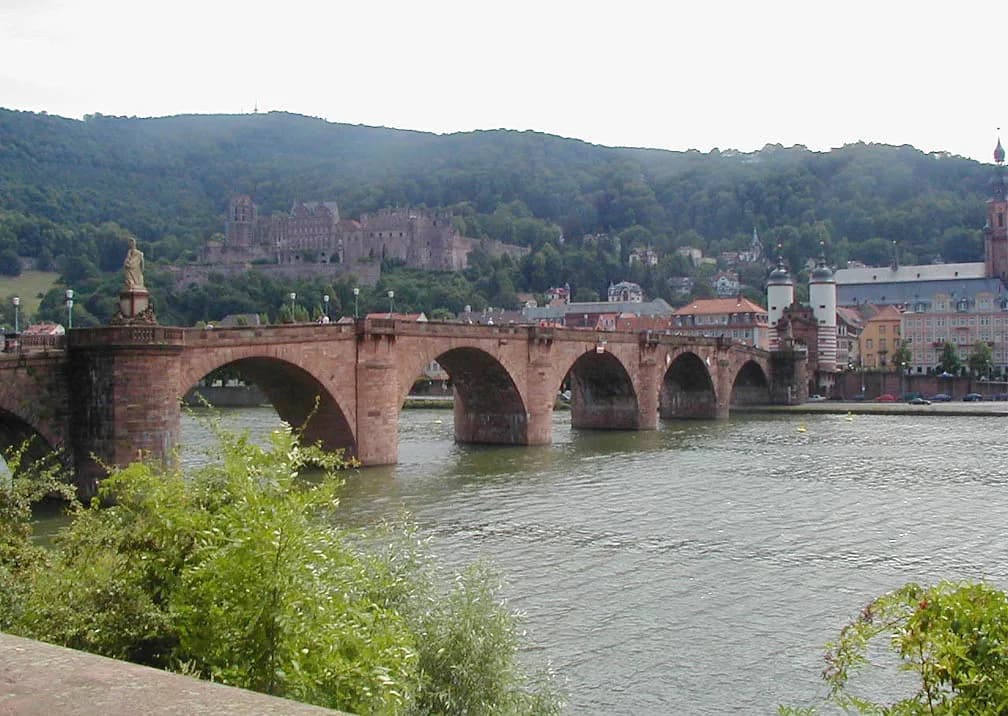
The Old Bridge is the natural midpoint and viewpoint of the walk, and Heidelberg Marketing notes it is made of Neckar Valley sandstone. Reaching it changes the experience: the streets open onto the river, and the view back toward the castle and the old town gives you a sense of the whole layout at once. This is a good place to pause rather than push straight across.
Once on the bridge, look both ways along the Neckar rather than only at the far bank. The riverbank itself, including the Neckarwiese, is described by Heidelberg Marketing as a place for relaxation and games, so the atmosphere shifts from sightseeing to leisure as you move along the water. If you have time, walking a stretch of the bank extends the route without adding another ticketed stop.
A Suggested Self-Guided Sequence and Timing
A practical sequence is to begin at Marktplatz, spend time with the church on the square, move into the university quarter, and then walk down to the Old Bridge, finishing along the river if you have energy left. As a suggestion rather than a rule, allow about an hour and a half on foot so the squares do not feel rushed; the operator's public tour runs 1 hour 30 minutes, which is a useful reference point even though this route is self-guided. Slower walkers can cut the university detour and still see the core.
Keep the order flexible: if a square is crowded, move on and return later rather than queuing for a photo. The route is short enough that a second pass costs little time, and the light changes how the streets and the bridge look. Treat any published distance figure for the old town as approximate and route-dependent rather than an official measurement of this walk.
If You Have Longer: Optional Extensions
With more time, the riverside and the surrounding hills become natural add-ons rather than mandatory stops. Heidelberg Marketing highlights the Philosopher's Walk for panoramic views and the Königstuhl as the city's local mountain, both of which extend the day beyond the old town streets. A Heidelberg two day itinerary can fold this walk into a broader visit without repeating the same ground.
If you would rather leave the city for part of the day, day trips from Heidelberg include options such as Schwetzingen Palace, which suits travellers staying more than one night. These are extensions, not part of the Altstadt route, so decide based on your remaining time and energy rather than trying to combine everything. Keeping the walk itself uncluttered is what makes the old town memorable.
Practical Rhythm: Timing, Weather and Group Pace
Mornings tend to be quieter in the old town, which makes the squares and the bridge easier to enjoy before tour groups build up. Weather shapes the walk more than the route does: the streets and bridge are exposed, so rain or strong sun changes where you linger. Plan the walk as a flexible block rather than a fixed schedule so you can adjust to conditions.
Groups move at different speeds, so agree on a meeting point such as Marktplatz or the bridge rather than trying to keep everyone together. Anyone who wants to sit out a stretch can wait in a café while the rest continue. Because the route is short and the stops are close, regrouping is easy and does not require a fixed timetable.
What This Route Deliberately Does Not Cover
This walk does not attempt to cover paid interiors, ticketed collections or site-specific rules, because those depend on the institution, the day and the season. It also avoids stating opening hours for churches or university buildings, since those can change and are best checked directly. Where a stop has its own admission, treat that as separate from the street-level walk rather than assuming one ticket covers everything.
Accessibility, exact route distances and public transport details are also outside the scope here, because they vary by traveller and by current conditions. If any of those matter for your visit, confirm them through official channels before you set out. The route is designed to be adaptable rather than prescriptive.
Plan Your Visit
Heidelberg's Altstadt works well on foot because its squares, churches, university buildings and the Old Bridge sit close together, so a self-guided route needs structure rather than distance. Start at Marktplatz, treat the churches and university as working places, and let the bridge be your midpoint before deciding whether to extend along the river. A suggested hour and a half keeps the pace comfortable without skipping the core.
Before you go, check current tour dates, access arrangements and any notices with Heidelberg Marketing, and treat nothing about opening arrangements as guaranteed. The walk itself is free at street level, while interiors and guided options are separate decisions. Plan loosely, verify what matters, and let the old town set the pace.
Frequently Asked Questions
Is the Heidelberg Old Town walking route free?
Walking the streets, squares and the Old Bridge is free at street level, and that is what this route describes. Paid options exist separately: Heidelberg Marketing lists a public guided Altstadtrundgang with its own price and meeting point, and individual interiors may charge admission on their own terms. Check current details with Heidelberg Marketing before relying on any specific access or fee.
How long does a self-guided walk through Heidelberg's Altstadt take?
As a suggestion, allow about an hour and a half on foot so the squares and the bridge do not feel rushed. For reference, Heidelberg Marketing lists its public Altstadtrundgang tour with a duration of 1 hour 30 minutes, but that is the operator's guided format, not a fixed duration for a self-guided walk. Slower walkers can shorten the route by skipping the university detour.
Should I walk the old town on my own or join a guided tour?
Walking on your own gives you control over pace and lets you linger where you like, which suits the compact Altstadt well. A guided tour adds commentary and a fixed structure, and Heidelberg Marketing publishes a public Altstadtrundgang from a set meeting point at Neckarmünzplatz. Choose based on whether you want narration or flexibility, and verify current tour dates and availability before booking.
Can I visit the churches and university buildings along the route?
These are working institutions rather than open attractions, so exteriors are reliably visible while interiors depend on current use. Churches may be open for worship or quiet visits but not for sightseeing at every hour, and university buildings are in everyday academic use. Look for posted information at the entrance and accept that access may not be possible on the day.
Is the Old Bridge part of the old town walk?
Yes. The Old Bridge, built of Neckar Valley sandstone according to Heidelberg Marketing, is the natural midpoint and viewpoint of the route. Crossing it or pausing on it changes the perspective, showing the river, the castle and the old town together. From there, the riverbank is an easy extension if you have more time.


