El Rastro Market doesn't sell tickets, because there's nothing to buy — entry is completely free, every Sunday and public holiday from 9am to 3pm, in Madrid's La Latina district. That's the short answer to the most-searched question about it. What takes more explaining is everything else: what's actually worth timing your Sunday around, how to dodge both the crowds and the pickpockets, and where the market's edges blur into the tapas bars everyone ends up in by early afternoon.
This guide covers what El Rastro is, what it costs (nothing, unless you buy something), when to go, how long to budget, how to get there, and the mistakes that trip up first-time visitors. It's part of our full Madrid attractions guide.
What Is El Rastro Market?
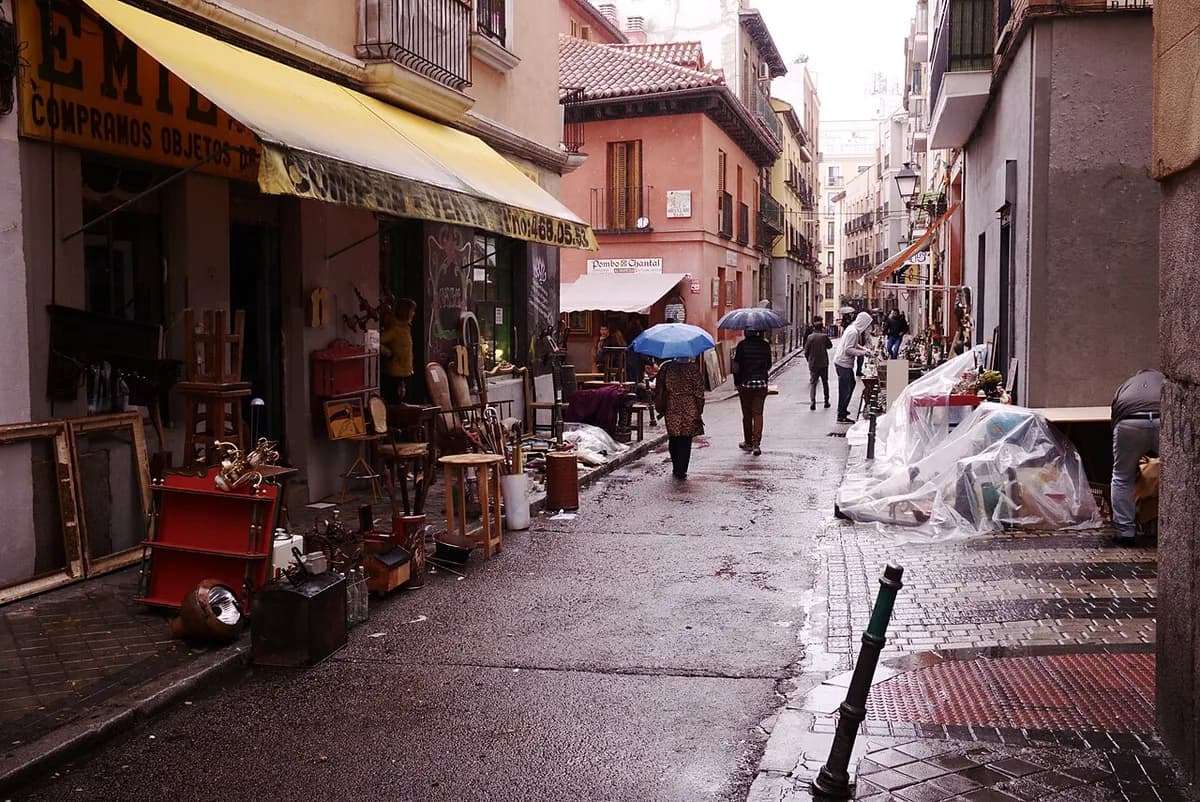
El Rastro is Madrid's largest and most famous open-air flea market, filling the streets of La Latina south of Plaza Mayor every Sunday and public holiday. More than 1,000 vendors typically set up on a busy Sunday, lining Calle de la Ribera de Curtidores and the side streets branching off it — from Plaza de Cascorro down toward Puerta de Toledo — selling everything from genuine antiques and art to secondhand clothing, vinyl records, trading cards, tools, pets, and the kind of household odds and ends that don't fit any single category.
The market's roots go back to at least 1740, when it operated as a hub for trading secondhand clothes. One theory behind the name — rastro means "trail" or "trace" in Spanish — ties it to a former slaughterhouse nearby, whose blood trail is said to have run down the street that gave the market its name. Nearly 300 years later, El Rastro is still one of the largest flea markets in Europe, and it's kept its reputation as the place locals go hunting for something specific, even as it's become one of Madrid's essential tourist stops. If you want more spots like this away from the headline sights, our Madrid hidden gems guide has a longer list.
Tickets & Prices 2026
There's no admission fee and no ticket to buy. El Rastro is a public street market, not a paid attraction, and it's free to walk through at any time it's open. What you spend is entirely up to what you buy from the stalls — prices are set by each individual vendor rather than by the market itself, and haggling is normal, especially on higher-priced antiques and furniture.
The word "tickets" shows up in searches mostly because travel booking platforms list guided walking tours of El Rastro and La Latina — small-group experiences led by a local guide that typically pair the market with a tapas or vermouth stop afterward. These are optional add-ons, not entry requirements, and pricing varies by operator, group size, and inclusions, so check current rates directly on the booking platform rather than assuming a fixed cost. For most travelers, walking the market on your own with no advance booking is the simpler — and cheaper — way to see it.
Opening Hours & Best Time to Go
El Rastro runs every Sunday and public holiday from 9am to 3pm. There's also a smaller monthly edition called "Rastro Saturdays," held the first Saturday of every month except July, August, and November, on the same 9am–3pm schedule — a useful option if your trip doesn't line up with a Sunday. Confirm the current calendar on Madrid's official tourism site before you plan around it, as of mid-2026, since holiday and Rastro Saturday dates shift from year to year.
Arrive close to opening, around 9 to 10am, for the calmest browsing and the best shot at first pick of antiques and vintage finds — serious collectors do exactly this. By late morning the main strip is dense with both shoppers and slow-moving crowds, and by early afternoon some vendors are already packing up ahead of the official 3pm close, so don't leave your visit to the last hour. A sunny Sunday morning is when the market is liveliest, but it's also when it's most crowded — a slightly overcast Sunday, if you get one, tends to be noticeably easier to move through.
How Long to Plan
Budget 1.5 to 2 hours to walk the main stretch of Calle de la Ribera de Curtidores and its side streets at a normal pace. If you're seriously hunting for antiques, art, or something specific, plan on 3 hours or more — the market spreads across a genuinely large area, and the best finds are often down the side streets that casual visitors skip. Most people naturally end their visit by drifting into one of La Latina's bars for a late-morning vermouth once they've seen enough, which is as much a part of the Sunday ritual as the market itself. If you're mapping out a fuller day around it, our 2-day Madrid itinerary shows where El Rastro fits alongside the city's other major sights.
How to Get There
El Rastro is centered on Plaza de Cascorro in La Latina, about a 10-minute walk south of Plaza Mayor and the historic center. The closest metro stations are Embajadores (Lines 3 and 5) and La Latina (Line 5), both a short walk from the market's northern end, with Puerta de Toledo (Line 5) convenient for the southern end near Ronda de Toledo. All three put you within a few minutes' walk of the stalls.
Driving isn't practical — the surrounding streets are pedestrianized or closed to traffic during market hours, and parking in central Madrid on a Sunday is limited. If you're coming from the historic center, walking is the fastest option regardless of which metro line you'd otherwise take.
Visit Tips: Crowds, Safety & Common Mistakes
El Rastro's biggest practical hazard isn't the market itself — it's pickpockets, and local guides are consistently upfront about it. The crowded main strip, particularly around Plaza de Cascorro and the busiest stretches of Ribera de Curtidores, is the highest-risk area. Keep bags zipped and in front of you, keep your phone in a front pocket rather than a back one, and treat this like any dense, crowded street market anywhere in the world — the market itself is safe, but pickpocketing here is a genuinely more common risk than on an average Madrid street.
Most stalls run on cash, so bring small bills — larger antique and furniture vendors are more likely to take cards, but don't count on it at the smaller stalls. Haggling is normal for anything beyond the smallest items; the asking price is rarely the final price. The most common first-timer mistake is treating El Rastro like a scheduled attraction with a fixed route — it rewards wandering more than following a set path, and the best finds are usually down the side streets that thin out the crowds. Arriving after 1pm expecting a leisurely browse right up to closing is the second most common misstep; build your visit earlier in the window instead.
Nearby Attractions
El Rastro sits close enough to central Madrid that it pairs naturally with a morning or afternoon of sightseeing. The Plaza Mayor, Madrid's grand 17th-century central square, is about a 10-minute walk north and makes a natural stop before or after the market. The Royal Palace of Madrid, one of the largest royal residences in Europe still used for state ceremonies, is roughly 15 to 20 minutes on foot from Plaza de Cascorro, or a short ride via La Latina metro station. If you'd rather trade market crowds for green space afterward, Retiro Park is a short metro ride away and is an easy way to unwind once you've had enough of the stalls.
La Latina's bar scene is arguably as much a part of the Sunday ritual as the market itself. Once the stalls start thinning out around 2 to 3pm, the neighborhood's streets — Cava Baja in particular — fill with locals doing vermú, Madrid's Sunday midday tradition of vermouth and small tapas. It's the natural, unforced way to end an El Rastro morning.
Frequently Asked Questions
Frequently Asked Questions
Do you need to buy tickets for El Rastro Market?
No. El Rastro is a free, open-air public market — there's no admission fee and nothing to book to walk through it. The "tickets" travelers see advertised online are for optional guided walking tours of the market and La Latina, not entry passes; you don't need one to visit.
What are El Rastro Market's opening hours?
El Rastro runs every Sunday and public holiday from 9am to 3pm. There's also a smaller "Rastro Saturdays" edition on the first Saturday of most months (except July, August, and November), on the same 9am–3pm schedule. Confirm current dates on Madrid's official tourism site before planning a Saturday visit.
Is El Rastro Market open on Saturdays?
Only occasionally. The regular market runs Sundays and public holidays. "Rastro Saturdays" adds the first Saturday of every month except July, August, and November — so most Saturdays it's closed, and it's worth checking the calendar rather than assuming a Saturday visit will work.
Is El Rastro Market safe from pickpockets?
The market itself is safe, but pickpocketing is a real and commonly flagged risk in the busiest, most crowded stretches, particularly around Plaza de Cascorro. Keep bags zipped and in front of you and keep your phone in a front pocket — the same precautions worth taking at any dense, crowded street market.
What's the best time to visit El Rastro Market?
Arrive close to opening, around 9 to 10am, for the calmest browsing and best access to early finds before the crowds build. The market gets progressively busier through late morning and starts thinning out by early afternoon as vendors pack up ahead of the 3pm close.
El Rastro doesn't need a ticket, a booking, or a plan beyond showing up on a Sunday morning — which is both its appeal and the reason it can feel disorganized to first-time visitors expecting a conventional paid attraction. Come early, keep an eye on your bag, and treat the wandering as the point rather than a means to a specific purchase.
Pair it with a walk to the historic center beforehand or a vermú in La Latina afterward, and a free Sunday morning turns into one of the more distinctly Madrid experiences you can have in 2026.
For current official information, see El Rastro on Wikipedia.