
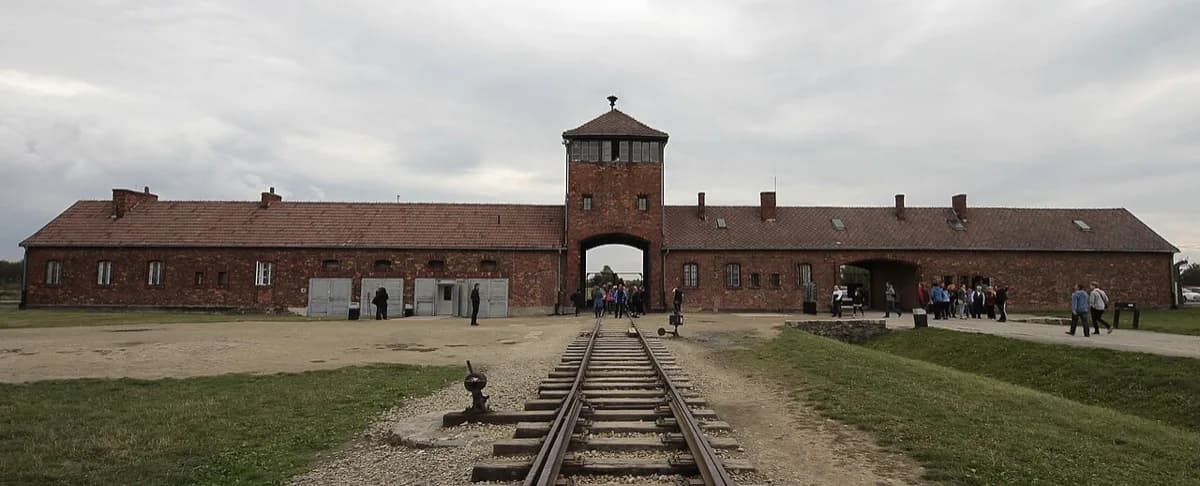
Admission to the grounds of the Auschwitz-Birkenau Memorial and Museum is free, but access runs on a timed entry-pass system: from 7:30 a.m. until early-to-mid afternoon — the exact cut-off shifts by month, from around 1:00 p.m. in December to as late as 7:00 p.m. in July and August — entry is only possible as part of a guide-educator tour, and those tours regularly sell out days in advance in summer, especially the 9:00–11:00 a.m. slots from Thursday to Saturday. That single fact trips up more visitors than anything else about planning a trip here.
This guide is built around what people actually need to decide before going: whether the visit is worth the emotional weight, what to do if the official booking site shows no availability for your date, how many hours to realistically set aside, and whether a self-guided visit is even possible. It also covers the practical basics — hours, cost, and getting there from Krakow.
What Is Auschwitz-Birkenau Memorial?
Auschwitz-Birkenau was the largest of the concentration and extermination camps built by Nazi Germany during the Second World War, located near the town of Oświęcim, about 70 kilometers west of Krakow. The Germans established Auschwitz I in 1940 in a former Polish army barracks complex, then built the much larger Auschwitz II-Birkenau camp roughly 3 kilometers away in 1942 to carry out mass extermination on an industrial scale, primarily of European Jews. Historians estimate that around 1.1 million people, the vast majority Jewish, were murdered at the two camps between 1940 and 1945, alongside Polish political prisoners, Roma and Sinti people, Soviet prisoners of war, and other groups targeted by the regime.
Soviet troops liberated the camps on January 27, 1945 — the date now marked worldwide as International Holocaust Remembrance Day. The Polish government established the Auschwitz-Birkenau State Museum on the site in 1947, preserving original barracks, guard towers, the railway spur into Birkenau, and thousands of victims' personal effects. UNESCO inscribed the site as a World Heritage Site in 1979. Today the museum operates across both camps: Auschwitz I holds the main exhibition buildings and visitor center, while the larger, more skeletal Auschwitz II-Birkenau preserves the scale of the camp's rail platform and the ruins of the demolished gas chambers.
Is Auschwitz-Birkenau Worth Visiting?
Short answer: yes, for nearly every traveler capable of handling a heavy, sobering few hours — but "worth it" here doesn't mean enjoyable the way a castle or a viewpoint is. This is a memorial and a mass grave before it is a tourist attraction, and it is widely treated, including across the traveler threads on Reddit's r/poland and TripAdvisor's reviews of the museum, as one of the most important historical sites in Europe to see in person rather than only read about.
The case for going: walking the actual barracks, the rail platform at Birkenau, and the preserved rooms of confiscated belongings communicates the scale of the Holocaust in a way documentaries and textbooks don't fully replicate. Most visitors describe leaving changed, not entertained — which is the point of a memorial like this one.
The case for skipping it, or postponing: this isn't a good fit for young children, for anyone in a currently fragile emotional state, or for a trip where only a rushed hour or two in the area is possible. If your time is genuinely tight and your 2 days in Krakow itinerary is already packed, it's worth prioritizing on a future trip instead of cramming it in as an afterthought.
Tickets & Prices 2026
Entry to the memorial grounds themselves is free — the museum states this plainly. What costs money is the guide-educator tour, which is mandatory for individual visitors during the core hours (roughly 7:30 a.m. to early or mid afternoon, depending on the month) and mandatory for all group visitors at any time. Exact 2026 per-person tour pricing isn't published as a static table on the official site; it's set at booking on visit.auschwitz.org, the only place entry passes can be reserved — none are sold at the gate. Independent guided day trips from Krakow that bundle transport with a licensed educator run from roughly 100–175 PLN (about €23–40) per person depending on group size and whether transfer is included, which gives a reasonable ballpark for what the experience costs even outside a self-arranged visit.
Booking opens daily at 12:00 noon, 90 days ahead of the visit date for individual visitors, and there's no refund once a tour slot is paid for — decide on your date and time before confirming. If the official system shows your preferred slot as sold out, later afternoon self-guided entry passes (free, released once the guide-educator requirement lifts for the day) are sometimes still available; check for last-minute cancellations closer to your date; or book through a licensed Krakow-based tour operator, several of which hold separate block allocations that can still have space when the official portal is full.
Opening Hours & Best Time to Go
The museum opens daily at 7:30 a.m., with closing time shifting by month according to official visiting information: 2:00 p.m. in December; 3:00 p.m. in January and November; 4:00 p.m. in February; 5:00 p.m. in March and October; 6:00 p.m. in April, May, and September; and 7:00 p.m. in June, July, and August. Visitors may remain on site up to 90 minutes after the final entrance hour. The memorial is closed on January 1, Easter Sunday, and December 25.
For a calmer visit, aim for a late-afternoon slot outside the peak 9:00–11:00 a.m. window, and avoid Thursday through Saturday in July and August if you have flexibility — that's when tour buses and group bookings cluster hardest. Shoulder-season months (spring and early autumn) are noticeably quieter than the summer peak while still offering full opening hours.
How Long to Plan for Your Visit
The museum recommends at least 3.5 hours on site to cover both Auschwitz I and Auschwitz II-Birkenau properly — the two camps are physically separate, connected by a short shuttle bus, and rushing between them undercuts the point of visiting at all. If you're coming from Krakow as a day trip with transfer included, budget a full day: independent tour operators quote 7–8 hours door to door once transport, security screening, and both camps are accounted for.
Don't try to bolt this onto a half-day already earmarked for something else in the city. It doesn't pair well with a packed sightseeing schedule the same day — treat it as the single focus of whichever day you visit.
How to Get There from Krakow
Auschwitz-Birkenau sits about 70 kilometers west of central Krakow, roughly 1.5 hours by road. Direct minibuses run regularly from Krakow's Main Bus Station (MDA) to Oświęcim, with a short local shuttle or a 15–20 minute walk from the Oświęcim bus stop to the museum entrance. This is the cheapest independent option and doesn't require booking a tour package. Organized day trips with transfer included pick up from central Krakow hotels and handle the routing directly to the visitor entrance, which is worth the extra cost if you'd rather not manage bus timings on a day that's already emotionally demanding.
Driving is straightforward via the A4 and S1 motorways, with paid parking near the site, though for a single-focus day trip most visitors find public transport or an organized tour simpler than self-driving. If you're building out a broader regional itinerary, our day trips from Krakow guide covers how this fits alongside other out-of-city options, and the full Krakow attractions guide rounds out what else to see in the city itself.
Visit Tips: Queues, Booking & Mistakes to Avoid
Book a named time slot in advance — walking up without a reservation during core hours will very likely mean turned away, not a wait in line. Arrive at least 30 minutes before your scheduled tour time for the security check. Bags and backpacks can't exceed 35 x 25 x 15 cm; larger luggage has to stay in your car or with your tour operator, since there's no cloakroom for oversized bags at the entrance.
The most common mistake is treating this like a flexible, drop-in sight the way you might treat a castle or a market square. It isn't — entry cards are online-only, tours run on fixed schedules, and there are no refunds if your plans change. The second most common mistake is underestimating time: don't schedule a train, flight, or another major activity for the same afternoon. Dress and behave with the solemnity the site calls for, and plan your meals beforehand, since on-site food options are limited and breaks between camp sections are brief.
Nearby Attractions
Several Krakow-based operators combine an Auschwitz-Birkenau morning with an afternoon stop at the Wieliczka Salt Mine, on the opposite side of Krakow — it's a long day, but doable if you start early and both slots are booked in advance. For a thematically connected stop back in the city, the Schindler's Factory museum in Podgórze covers Krakow's own WWII occupation history and pairs naturally with an Auschwitz-Birkenau visit on a different day of the same trip.
For travelers based in central Krakow, Wawel Castle anchors the Old Town's core sights and is worth reserving for a separate, lighter day — most visitors find it's not a good idea to schedule a major historical landmark like this immediately before or after Auschwitz-Birkenau on the same day.
Frequently Asked Questions
Frequently Asked Questions
Is Auschwitz-Birkenau worth visiting?
Yes, for nearly every traveler capable of handling a heavy, sobering few hours — it's a memorial before it's a tourist attraction, and it's widely regarded as one of the most important historical sites in Europe to experience in person. It isn't a good fit for young children, anyone in a fragile emotional state, or a trip where only a rushed hour is available.
What happens if Auschwitz-Birkenau tickets are sold out?
Morning slots regularly sell out days in advance in summer, especially Thursday through Saturday. If your date shows sold out on the official portal, check for later-afternoon self-guided entry passes, watch for last-minute cancellations closer to your date, or book through a licensed Krakow-based tour operator that may hold a separate allocation.
How long does it take to visit Auschwitz-Birkenau?
The museum recommends at least 3.5 hours on site to properly cover both Auschwitz I and Auschwitz II-Birkenau. If you're visiting as a day trip from Krakow with transfer included, budget a full day — around 7 to 8 hours door to door once transport and security screening are factored in.
Do you need a guide to visit Auschwitz-Birkenau?
During core hours — roughly 7:30 a.m. to early or mid afternoon depending on the month — individual visitors and all groups must join a guide-educator tour. Outside those hours, a limited number of free self-guided entry passes are released, but availability is inconsistent, so most visitors plan around the guided tour system.
Is Auschwitz-Birkenau free to visit?
Admission to the memorial grounds is free of charge. The cost applies only to the guide-educator tour, which is required for individual visitors during core hours and for all groups at any time. Entry passes must be reserved online in advance at the official booking portal; none are sold at the gate.
Auschwitz-Birkenau isn't a "worth it" question in the usual travel-blog sense — it's less about whether the experience delivers and more about whether you're ready for what it asks of you. For most travelers with a genuine interest in understanding this period of history, it is worth the planning it takes to get a booked slot and set aside a full, unhurried day.
Book your entry pass as early as your dates allow, plan for a minimum of 3.5 hours on site plus travel time from Krakow, and don't schedule anything demanding on either side of the visit. Confirm current hours and booking availability directly on the official site before you travel, since both shift by season.
For current official information and to book entry passes, see the Auschwitz-Birkenau Memorial and Museum official visiting guide.