
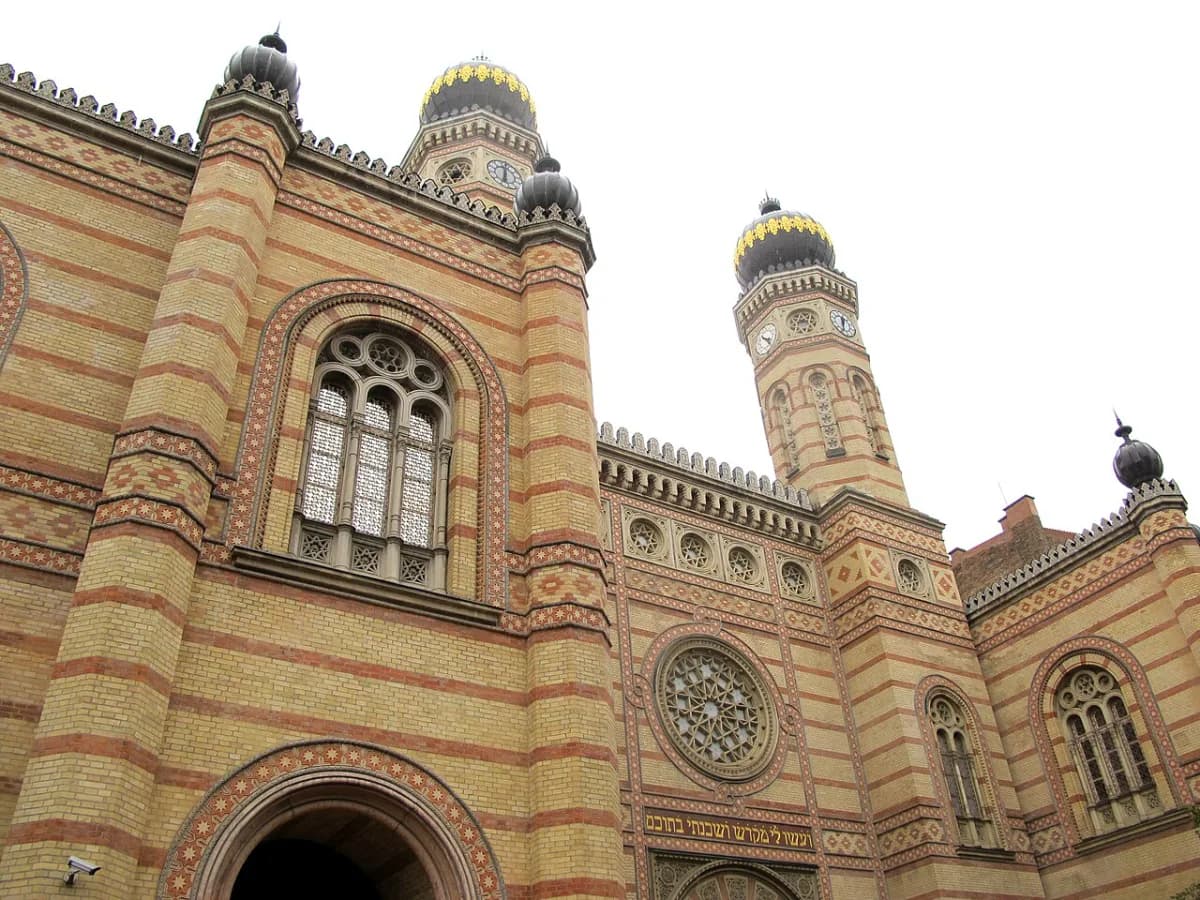
The Dohány Street Synagogue is the largest synagogue in Europe and the second-largest in the world, and its complex — the sanctuary itself, the Jewish Museum, the Heroes' Temple, the historic cemetery, and the Raoul Wallenberg Memorial Park — is one of Budapest's most-visited paid sights. As of mid-2026, a fast-track entry ticket runs from around €40 per person, guided-tour options that include synagogue access start from roughly €54–€69, and children under 6 go free. The detail that trips up more visitors than the price: the entire complex is closed every Saturday for Shabbat, with no exceptions.
This guide covers current 2026 prices, the seasonal opening-hours schedule, how much time to budget, how to get there from central Pest, and the booking mistakes worth avoiding — plus where the synagogue fits alongside the rest of the Jewish Quarter and central Budapest.
What Is the Dohány Street Synagogue?
The Dohány Street Synagogue (Dohány utcai zsinagóga), also known as the Great Synagogue, sits on Dohány utca in Erzsébetváros, Budapest's historic Jewish Quarter (District VII). It was built between 1854 and 1859 to a design by Viennese architect Ludwig Förster, with interior work by Frigyes Feszl, in the Moorish Revival style — a deliberate architectural choice that referenced the perceived "oriental" roots of Judaism and was fashionable for synagogue design across 19th-century Central Europe. It seats roughly 3,000 people, split between a ground-floor nave and wraparound balconies, and remains the largest synagogue in Europe and the second-largest in the world after Temple Emanu-El in New York.
The complex extends well beyond the sanctuary. The attached Jewish Museum, founded in 1930 on the site of Theodor Herzl's birthplace — the founder of modern political Zionism — holds ceremonial objects and a Holocaust room documenting the near-destruction of Hungary's Jewish community in 1944–45. Behind the synagogue, the cemetery holds roughly 2,000 graves, an exception to Jewish law, which normally forbids burial grounds next to a synagogue; it became necessary because thousands of Budapest Ghetto residents died here during the brutal winter of 1944–45 and had to be buried close to where they fell. The adjoining Raoul Wallenberg Memorial Park holds Imre Varga's Tree of Life sculpture, a metal weeping willow whose leaves are inscribed with victims' names, honoring the Swedish diplomat credited with saving tens of thousands of Budapest Jews.
Dohány Street Synagogue Tickets & Prices 2026
Entry to the Dohány Street Synagogue complex is ticketed, and pricing runs through a handful of official and third-party booking channels rather than a single fixed ticket-office rate. As of mid-2026, a fast-track skip-the-line ticket covering the synagogue, museum, cemetery, and memorial park runs from around €40 per person; guided tours that include the same access start from roughly €54–€69 per person, depending on group size and language. Children under 6 are admitted free. Discounted student and senior rates are available at the on-site ticket counters — bring valid ID, since exact discount amounts aren't consistently published online.
Because prices are reviewed periodically and different vendors list different rates, confirm the current figure on the official site before you book, and be cautious of steeply discounted third-party listings that may exclude the museum or memorial park. Booking online in advance is worth doing in peak season (May–September), when on-site ticket-counter queues can run 30 minutes or longer.
Wondering whether a city pass beats paying per site? Our guide to whether the Budapest Pass is worth it covers whether bundling synagogue entry into a pass saves money over booking directly.
Opening Hours & Best Time to Visit
The Dohány Street Synagogue runs a seasonal schedule that shifts four times a year, and the complex closes completely every Saturday for Shabbat regardless of season:
- Winter (Jan 7–Feb 28, Nov 2–Dec 31): Sunday–Thursday 10:00–16:00, Friday 10:00–14:00
- Spring (Mar 1–May 23): Sunday–Thursday 10:00–18:00, Friday 10:00–16:00
- Summer (May 24–Sep 30): Sunday–Thursday 10:00–20:00, Friday 10:00–16:00
- Autumn (Oct 1–31): Sunday–Thursday 10:00–18:00, Friday 10:00–16:00
Last entry is one hour before closing across all seasons. The complex also closes or runs reduced hours for major Jewish holidays, including Passover and the High Holy Days (Rosh Hashanah and Yom Kippur) — check the official site for exact closure dates if your trip falls in spring or early autumn.
Early morning on a weekday (Sunday through Thursday) is the calmest time to visit; Friday afternoons get busy before the shortened closing time, and any day in July or August draws the heaviest tour-group traffic. Since Shabbat closes the complex entirely on Saturdays, build that into your itinerary rather than discovering it at the door.
How Long Do You Need to Visit?
Budget 1 to 1.5 hours for a full visit covering the synagogue interior, the Jewish Museum, the cemetery, and the Wallenberg Memorial Park. The synagogue nave alone can be seen in 20–30 minutes, but most tickets bundle in the museum and grounds, and skipping them means missing the cemetery and Tree of Life memorial — two of the more affecting parts of the site. Guided tours typically run 45 minutes to an hour for the synagogue portion, with the museum and grounds available to explore afterward at your own pace.
If you're building a broader day around the Jewish Quarter, pair the synagogue with a walk through the surrounding streets of courtyards and ruin bars, or fold it into a wider central-Pest day — see our 2-day Budapest itinerary for where it fits alongside the rest of the city.
How to Get to the Dohány Street Synagogue
The synagogue is at Dohány utca 2, 1074 Budapest, right at the edge of the Jewish Quarter in District VII. The closest metro stop is Astoria on the M2 (red) line, about a 3-minute walk away; Deák Ferenc tér, where all three metro lines meet, is roughly a 10-minute walk. Trams 47 and 49, plus buses 7 and 8E along the Grand Boulevard (Nagykörút), also stop within a few minutes on foot.
There's no dedicated visitor parking at the synagogue itself, and District VII's narrow one-way streets make driving in impractical for a single stop — public transport or a walk from a central Pest hotel is the simpler choice. The location puts it within easy walking distance of the rest of the Jewish Quarter's synagogues, courtyards, and ruin bars, so most visitors combine it with a broader neighborhood walk rather than a standalone trip.
Visit Tips: Queues, Booking & Common Mistakes
- Book online ahead in peak season (May–September) to skip the ticket-counter line, which can run 30 minutes or longer on summer afternoons.
- Modest dress is expected, and men are asked to cover their heads inside — kippahs are typically provided at the entrance if you don't bring your own.
- Security screening (bag check, metal detector) is standard at the entrance, similar to other Jewish heritage sites in Europe — arrive with a few extra minutes for it.
- Don't plan a Saturday visit — the entire complex, including the museum and memorial park, is closed for Shabbat with no exceptions.
- Photography is generally allowed in the synagogue and grounds but may be restricted during services or special events — check signage on arrival.
- If the cemetery and memorial park matter to you, confirm your ticket type includes them — some discounted or fast-track listings cover only the synagogue interior.
Nearby Attractions
The synagogue sits in central Pest, close to several of Budapest's other major sights. St Stephen's Basilica is about a 15-minute walk northwest, and the Hungarian Parliament Building is a further 10 minutes beyond that along the Danube, both easily combined into the same central-Pest day. Across the river, Fisherman's Bastion on Castle Hill makes a natural second stop if you're spending a full day sightseeing on both sides of the water.
For the wider range of things to see, the Budapest attractions hub covers other major sights worth combining with a Jewish Quarter visit.
Frequently Asked Questions
How much are Dohány Street Synagogue tickets in 2026?
As of mid-2026, a fast-track skip-the-line ticket covering the synagogue, Jewish Museum, cemetery, and Wallenberg Memorial Park runs from around €40 per person; guided tours with the same access start from roughly €54–€69. Children under 6 are free. Confirm the current price on the official site before booking.
What are the Dohány Street Synagogue's opening hours?
Hours change four times a year: winter (Jan 7–Feb 28, Nov 2–Dec 31) Sunday–Thursday 10:00–16:00 and Friday 10:00–14:00; spring (Mar 1–May 23) and autumn (Oct 1–31) Sunday–Thursday 10:00–18:00 and Friday 10:00–16:00; summer (May 24–Sep 30) Sunday–Thursday 10:00–20:00 and Friday 10:00–16:00. Last entry is always one hour before closing.
Is Dohány Street Synagogue open on Saturdays?
No. The entire complex — synagogue, museum, cemetery, and memorial park — is closed every Saturday for Shabbat, with no exceptions. It also closes or runs reduced hours for major Jewish holidays such as Passover and the High Holy Days.
What does a Dohány Street Synagogue ticket include?
Standard tickets cover the synagogue interior, the Jewish Museum, the Heroes' Temple, the historic cemetery, and the Raoul Wallenberg Memorial Park with its Tree of Life sculpture. Some discounted third-party listings cover only the synagogue interior, so check what's included before booking if the cemetery and memorial matter to you.
Do I need to book Dohány Street Synagogue tickets in advance?
It's not strictly required outside peak season, but booking online ahead is worth doing from May through September, when on-site ticket-counter queues can run 30 minutes or longer on busy afternoons.
The Dohány Street Synagogue rewards visitors who treat it as more than a photo stop: the Moorish Revival sanctuary is striking on its own, but the cemetery and Wallenberg Memorial Park behind it carry the more difficult, more essential part of the story — a reminder of the Budapest Ghetto's final winter. Setting aside 1 to 1.5 hours for the full complex, not just the nave, is the difference between a quick look and actually understanding the site.
Book ahead in peak season, dress modestly, and don't schedule around a Saturday — the complex is shut tight for Shabbat regardless of your itinerary. Confirm current 2026 prices and hours on the official site before you go, since both shift with the seasons and get reviewed periodically.
For current prices and hours, see the official Dohány Street Synagogue website and the official ticket and opening-hours page.