The Le Corbusier house on the Weissenhof Estate has housed the Weissenhofmuseum since 2006 and, according to the museum itself, is the only house in the settlement open to visitors. That single fact resolves most of the confusion around this Stuttgart landmark: the estate is a residential neighbourhood you walk through, while the museum is one building you enter. Plan your time around those two very different experiences before deciding how much of a day to give it.
The City of Stuttgart sets out the essentials clearly: 17 architects from five countries assembled under exhibition director Ludwig Mies van der Rohe, 33 houses built in just four months on Killesberg, and interiors designed around light, air and flexible living. Le Corbusier and Pierre Jeanneret contributed the semi-detached house, and their Corbusier buildings were added to the UNESCO World Heritage List in 2016. This is the framework worth understanding before you arrive on site.
What the Weissenhof Estate Is and Why It Exists
The estate grew out of the 1927 Deutscher Werkbund exhibition titled Die Wohnung, or The Dwelling, which used a hillside site on Killesberg to demonstrate how modern people might live. Rather than a single showpiece, the organisers built a whole small neighbourhood of prototypes in four months, treating the street itself as the exhibition. The city's own description frames the project as an answer to the question of how to live, with functional apartments that prioritised daylight and ventilation.
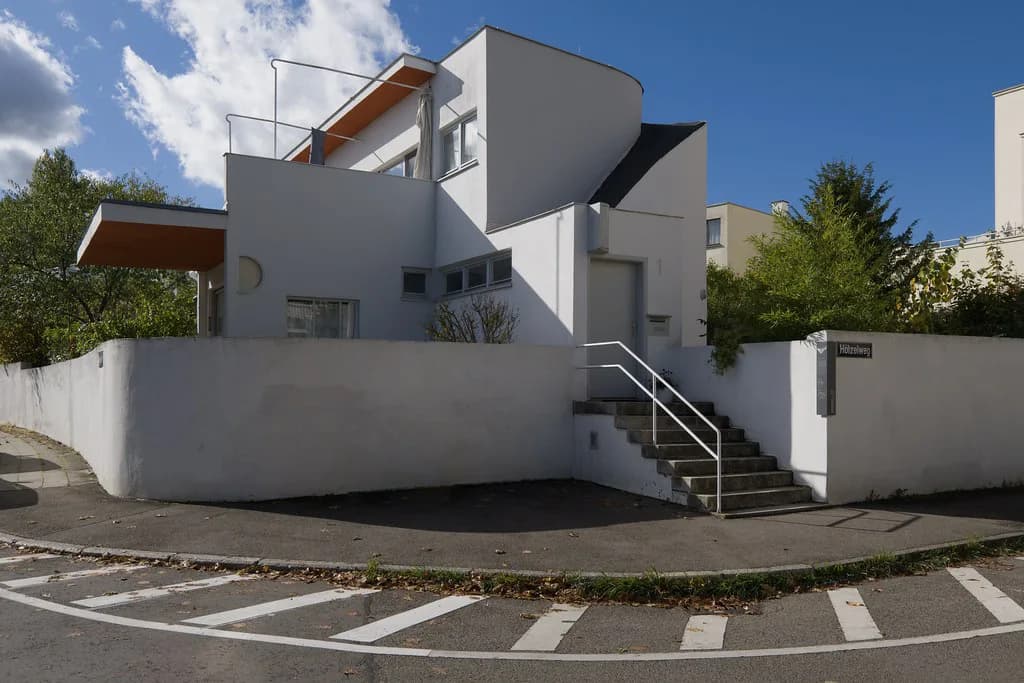
What makes the architecture legible on a walk is a small set of repeated ideas: flat roofs, long horizontal bands of windows, cubic volumes and an absence of applied ornament. Inside, the planners experimented with sliding walls, sliding beds and terraces so that a modest footprint could serve several purposes across the day. Some structures used then-novel materials such as lightweight concrete, corkboard and drywall, which is part of why the ensemble is regarded as a laboratory rather than a conventional housing scheme.
Mies van der Rohe and the Architects He Assembled
Ludwig Mies van der Rohe directed the exhibition and personally designed houses 1 to 4, which include the terraced apartment block that anchors the site. He recruited 17 representatives of the modern movement from five countries, a roster that included Walter Gropius, Hans Scharoun and Le Corbusier. Seeing so many competing national approaches within a few hundred metres is the estate's real draw.
An architectural reference listing credits Le Corbusier with houses 13 to 15, Gropius with 16 and 17, Mies van der Rohe with 1 to 4, Oud with 5 to 9 and Poelzig with 20. Those numbers are useful because the houses are not uniformly signed on site, so matching a facade to a name takes a little preparation. If you are walking without a guide, noting the numbering in advance turns a pleasant stroll into a genuine architectural comparison.
The Le Corbusier and Pierre Jeanneret House
Le Corbusier designed the semi-detached house with his cousin and partner Pierre Jeanneret, and it is the building most visitors come to see. Its celebrated feature is the living room conceived as a living machine, modelled on a train compartment, which converts into several sleeping cabins through a few simple manoeuvres, as the City of Stuttgart describes it. That single room is the clearest demonstration on the estate of how radically the architects rethought ordinary domestic routines.
The house now works as two halves with different jobs. One half presents the history of the entire settlement and the exhibition that produced it, while the other reconstructs the house as it was in 1927, according to the city. Understanding that split before you go helps you read the museum as an exhibition about a neighbourhood rather than a period-furnished home.
The museum's own site states plainly that the house is the only accessible house of the Weissenhof Estate and that the museum has occupied it since 2006. Anyone expecting to wander into Gropius's or Scharoun's interiors will be disappointed, because those remain private homes. Set expectations accordingly and the visit delivers exactly what it promises.
Inside Versus Outside: What You Can Actually Enter
The practical division is simple. The streets of the estate are open ground you can walk freely, and much of the architectural interest, from band windows to roof lines and corner details, reads perfectly well from the pavement. The interior experience is confined to the Le Corbusier house, where the museum displays the 1927 rooms and the settlement history and charges its own admission.
Admission prices, opening days and any seasonal changes are the museum's to publish, and they are not fixed facts you should assume in advance. Check the Weissenhofmuseum site shortly before you travel, since the details there are the ones that apply to your date. Building a walk around the free exterior and treating the interior as an optional add-on keeps the day flexible if the museum happens to be shut.
Because the estate is a lived-in neighbourhood rather than a fenced attraction, normal courtesies apply to gardens, doorways and parked cars. Photograph facades from the street and keep voices low near entrances. For anyone compiling a photography route, the estate's clean cubic geometry and horizontal glazing reward an early start when the light is even.
Three Status Layers That Are Often Confused
It helps to keep three separate milestones apart. The estate has been a listed building since 1958, the Le Corbusier house has operated as a museum since 2006, and the semi-detached house by Le Corbusier and Pierre Jeanneret was inscribed on the UNESCO World Heritage List in 2016 together with the Citrohan House. Each date describes something different: heritage protection, public access, and international recognition.
The 2016 listing covers the Corbusier buildings, not every house on the estate, so a plaque on one facade does not extend to its neighbours. The city describes the Corbusier houses as part of the UNESCO World Heritage Site, which is the accurate framing to carry with you. If world heritage status is your reason for coming, the Le Corbusier house is the part that carries it.
The Museum, the Digital Guide and the Centenary
The museum's news page reports that it is preparing a browser-based digital guide for the settlement's hundredth birthday, using 3D models and augmented reality to bring even demolished buildings back into view. The museum frames this as a way to reach diverse visitors, including children. Treat that as announced context rather than something to plan around until the museum confirms the guide is live.
The centenary framing connects to the IBA 2027, which the city presents as a moment to develop new visions for the Stuttgart urban region a century after the original international building exhibition. Programme details, events and any ticketing belong to the organisers, so confirm them directly closer to your travel date. What is safe to say is that the estate's profile is rising, which may mean busier conditions around anniversary periods.
Nearby, the Weissenhofwerkstatt occupies the Mies van der Rohe house and hosts changing exhibitions, which the museum documents separately from its own permanent displays. That distinction matters because a visit to the workshop is not the same as a visit to the Corbusier interior. If a temporary show is your motivation, check its own listing rather than assuming it runs alongside the permanent display.
Is the Weissenhof Estate Worth a Detour From Central Stuttgart?
For anyone with a genuine interest in twentieth-century architecture, the answer is yes, and the estate is a natural fit inside a longer day of city sightseeing. The walkable street plan means you can see a great deal without buying anything, which lowers the risk of a wasted trip if your timing is off. Pairing the estate with an afternoon elsewhere in the city keeps the day balanced. For wider planning, see Stuttgart city travel guides.
For travellers with only casual interest, the calculation changes. If your shortlist is dominated by palaces, museums and food, a hillside residential district may not justify the time, particularly if you cannot enter the museum on the day you visit. In that case, a quick look at the Mies block facades or a skip altogether is a reasonable call rather than a failure.
A middle path suits most visitors: go for the exterior, allow a suggested hour to walk the streets and read the facades, and add the museum if it happens to be open and you want the 1927 interiors. Two to three hours covers the estate comfortably at an unhurried pace; that is a planning suggestion, not an official duration. Family groups with young children may prefer to shorten the architecture walk and stretch the day with parks or a zoo instead. For wider planning, see Hidden Gems in Stuttgart.
Plan Your Visit
Decide first what you want from the Weissenhof Estate. If it is the architecture as a street experiment, the free exterior walk delivers it; if it is the 1927 interior and the settlement's story, the Weissenhofmuseum in the Le Corbusier house is the only place that provides it. Confirm current admission and opening details on the museum's own site before you commit a day to it.
Keep the estate's three dates straight as you plan: listed since 1958, museum since 2006, UNESCO World Heritage since 2016. That framing tells you what you are looking at and why the Corbusier house, not the whole neighbourhood, carries the international designation. With the right expectations, a short detour from central Stuttgart becomes a genuinely rewarding hour or two.
Frequently Asked Questions
Is the Weissenhof Estate free to visit?
Walking the streets of the estate is free, because it is an ordinary residential neighbourhood on Killesberg rather than a gated attraction. Entering the Weissenhofmuseum inside the Le Corbusier house is a paid visit, and the museum's own website is the place to confirm the current admission terms before you travel.
Is the Weissenhof Estate Bauhaus?
It is not Bauhaus in a strict institutional sense. The estate came out of the 1927 Deutscher Werkbund exhibition Die Wohnung, directed by Ludwig Mies van der Rohe, who assembled architects from five countries. Walter Gropius, a Bauhaus figure, contributed houses, and the projects share the era's modernist vocabulary of flat roofs, band windows and flexible interiors, but the estate is its own Werkbund enterprise.
Which Le Corbusier sites are UNESCO World Heritage and where does Stuttgart fit?
Stuttgart belongs to the transnational World Heritage listing of Le Corbusier's architectural work, added in 2016. The entries here are the semi-detached house by Le Corbusier and Pierre Jeanneret and the neighbouring Citrohan House, not the entire Weissenhof Estate. Other inscribed sites are spread across several countries, so the Stuttgart houses are one component of a much wider serial listing.