
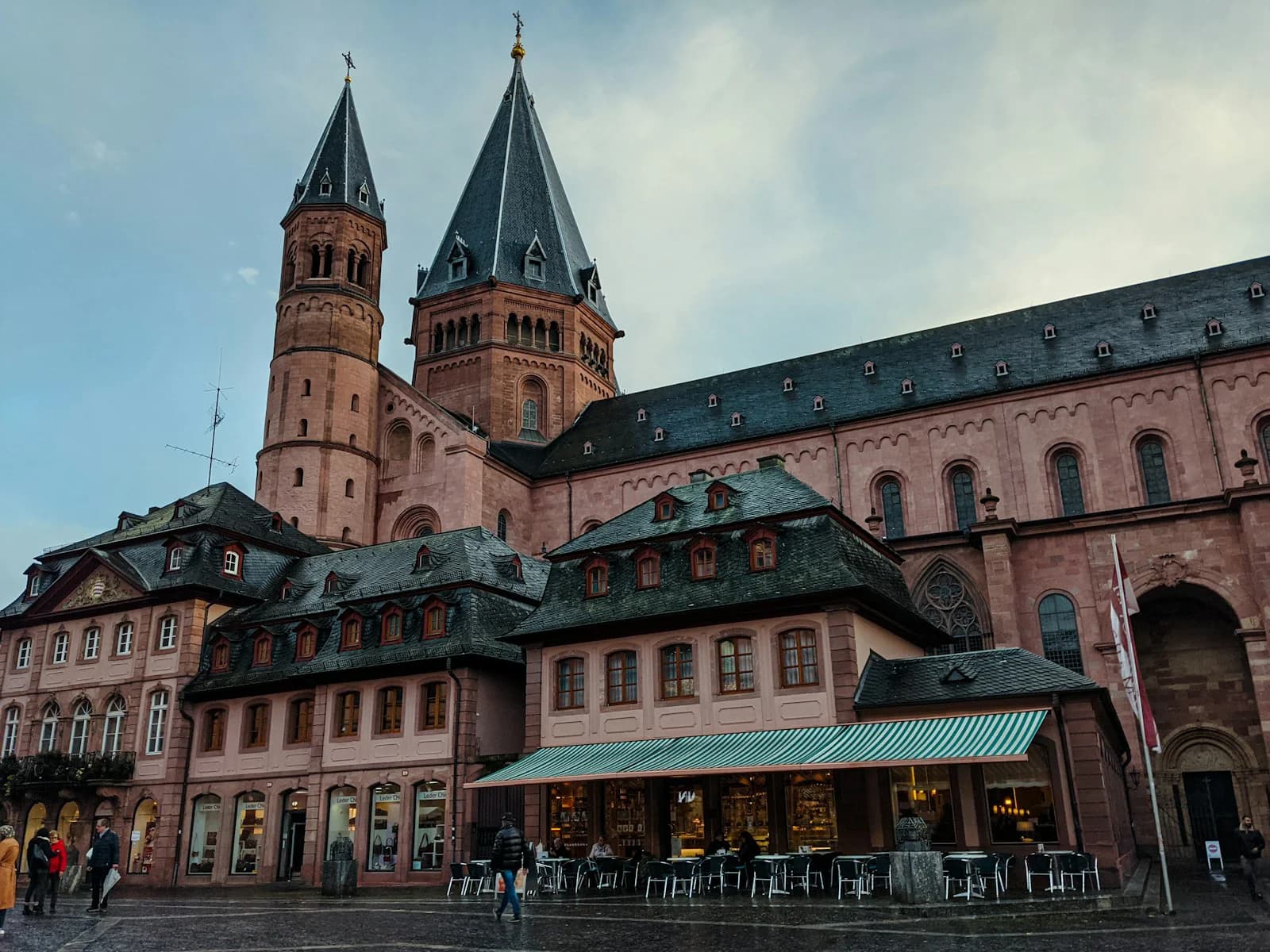
Arriving in Mainz across the Theodor-Heuss Bridge, the first building to make an impression is the Electoral Palace: a sandstone-red landmark stretching over 75 metres along the Rhine. It is one of the city's clearest introductions to its history as an electoral residence, and it can be appreciated without buying a ticket. This guide keeps the focus on what is genuinely outside — the riverfront and the facade — rather than promising interiors that may not be open. A suggested duration for the exterior and riverfront is around 20 to 30 minutes, though that is our editorial suggestion and not official guidance; add time if you want to sit by the water.
The palace is an outstanding example of the German late Renaissance, and it stands apart from its late Baroque neighbours, the former Teutonic Order House and the New Arsenal, because of the elaborate formal language of its facade. Construction began in the early 17th century under Elector Johann Schweikhard von Kronberg and proceeded in several phases. After severe destruction, especially in World War II, it was restored with considerable attention to detail and is now one of Mainz's architectural landmarks. The Grand Hall is known beyond the region as the venue for the televised Mainz carnival session.
Why the Electoral Palace Is Worth a Stop
Mainz has a Romanesque cathedral, a famous printing museum and a compact old town, so the palace earns its place by offering something different: a princely residence read from the outside, on the water. Its long Rhine frontage gives it a presence that few buildings in the city can match. If you only have time for one riverside stop, this is the one that explains the city's electoral past most directly.
The building also works as a punctuation mark in a city walk. You can pass it on the way between the old town and the river, then continue along the promenade without committing to a timed entry. Because the exterior is the main event for most visitors, the palace suits an unhurried but short stop rather than a half-day. Treat it as a landmark to look at and orient yourself by, not a museum to complete.
For orientation across the rest of the city, the local landmark guides for Mainz cover the cathedral, museums and riverside in more detail. They are useful if you want to build a full day around the palace rather than treat it as a single viewpoint.
Where the Palace Is and How It Fits a Mainz Walk
The palace address is Peter-Altmeier-Allee 9 in Mainz, on the edge of the old town and close to the Rhine. It sits by the approach to the Theodor-Heuss Bridge, which is why so many visitors see it first on arrival. The location is convenient: you can combine it with the old town on one side and the river on the other without a long detour.
The wider street pattern around the palace is easy to navigate on foot, with the cathedral, Schillerplatz and the Rhine promenade all reachable as part of the same stroll. If you are planning a route rather than a single stop, the city itinerary guides for Mainz help you sequence the old town, the river and the museum quarter sensibly.
For a self-guided walk that starts inland and works toward the river, a route through the old town pairs well with a finish at the palace frontage. That lets you see the contrast between narrow streets and the sudden open riverfront.
Reading the Facade: What Makes It Stand Out
The palace is described as an outstanding example of the German late Renaissance, and that is the key to reading it. Its facade is elaborate and rhythmically structured, which makes the neighbouring late Baroque buildings — the former Teutonic Order House and the New Arsenal — look heavier and more ornamented by comparison. Knowing this helps you see the palace as a deliberate stylistic statement rather than just an old building.
The sandstone-red colour comes from the local stone and gives the building its warm, almost uniform tone along the river. Look at how the facade is organised horizontally and how the roofline sits against the sky, rather than hunting for individual statues or carvings. The overall proportions are what visitors tend to remember.
A Suggested Viewing Loop: Exterior, Courtyard Approach and Rhine Perspectives
Start on the landward side, where you get the full width of the palace and can see how it meets the street. Then move toward the river for the long frontage view, which is the perspective that shows why the building is described as stretching over 75 metres along the waterfront. A suggested duration for the exterior and riverfront is around 20 to 30 minutes, but that is our suggestion rather than official guidance — add time if you want to sit by the water.
The courtyard approach is worth including if it is open when you visit, but it is not something to assume. Treat any entry beyond the public street as a bonus rather than a right, and if a gate or doorway is closed, simply continue along the outside. The Rhine-side perspectives are the reliable part of the visit.
Visiting Respectfully Around Current Institutional Use
The palace is a working building, not a ruin or a pure monument, so interior access cannot be assumed on a normal day. Even where guided access exists as a possibility, schedules and booking details are not published in a way we can state here, so the practical approach is to ask locally before you plan around it. The city's official pages are the place to check current arrangements rather than relying on old blog posts.
Respectful visiting here mostly means not treating doorways, courtyards or stairwells as photo backdrops if they are in use. Stay on clearly public ground, keep noise down near entrances, and avoid blocking the riverfront path for people passing through. If you see signs or barriers, they are there for a reason.
What You Can Realistically See from Outside
The honest answer is that the exterior and the Rhine setting are the certain parts of a visit, while the interior is not. The palace is celebrated as a cultural venue, and the Grand Hall is particularly renowned beyond the state borders as the venue for the television carnival session. That reputation does not mean the hall is open to casual visitors, so enjoy the building as an architectural landmark first.
The same caution applies to the courtyard: do not plan your day around standing inside it. If it happens to be accessible on the day you pass, you can take a quick look, but the reliable experience is the approach, the facade and the riverbank. This is a stop that rewards a slower look rather than a checklist.
Where the Roman-Germanic Central Museum Fits
The Roman-Germanic Central Museum is located in the Electoral Palace, which surprises some visitors who assume the palace is one single sight. The museum has a large collection spanning prehistoric times to the early Middle Ages and is especially known for its Roman material, including reconstructions of military equipment and everyday objects. Because it is a separate institution with its own arrangements, you should not assume that a palace visit and a museum visit share one ticket.
Check the museum's own current information for admission and opening before you go, and treat the palace location as a geographical fact rather than an access guarantee. If you are especially interested in the Roman period, the museum is worth planning around in its own right.
Pairing the Palace with Nearby Mainz Sights
The palace sits naturally between the old town and the water, so the easiest pairing is a walk that takes in the cathedral, the streets around Schillerplatz and then the river. The cathedral is the city's Romanesque anchor and gives you a useful contrast in scale and style. If you want the print-history side of Mainz, the Gutenberg Museum is another obvious addition for a longer day.
The riverside itself is worth lingering on after you have looked at the palace, since the promenade is where locals come to relax and watch the boats. A dedicated guide to the Mainz Rhine promenade visitor guide can help you plan that stretch without retracing your steps.
If museums are your priority, the Gutenberg Museum Mainz visitor guide covers the printing collections and practical visiting questions. For religious art and archaeology near the cathedral, the Cathedral and Diocesan Museum Mainz is the closer companion to a palace-and-river walk.
Practical Planning Notes Before You Go
Because the palace is in institutional use, the things most likely to change — interior access, any guided options, courtyard entry — are exactly the things you should confirm rather than assume. The city's official website is the safest starting point for current information, and the tourist office can answer questions about what is open on the day you plan to visit. Do not rely on a blog post or an old guidebook for access rules.
Allow flexibility in your schedule: if the palace grounds turn out to be more restricted than you hoped, the Rhine promenade and old town are immediately adjacent and will fill the time pleasantly. Wear shoes suitable for cobbles and riverside paths, and bring a layer for the wind that often funnels along the water. None of these are rules, just sensible defaults for a river city.
Plan Your Visit
The Electoral Palace rewards visitors who come for the exterior rather than for guaranteed interiors. Its sandstone-red late Renaissance facade, its long Rhine frontage and its place beside the Theodor-Heuss Bridge make it one of Mainz's most legible landmarks, and the surrounding old town and promenade turn a short stop into a satisfying half-day. Treat the palace as a public building you admire from public ground.
Check current access details with the city or the tourist office before you build your day around an interior visit, and keep your expectations centered on the architecture. Mainz as a whole is easy to explore on foot, so the palace can be one stop in a route rather than a destination that needs its own dedicated trip. That approach keeps the visit enjoyable whatever is open when you arrive.
Frequently Asked Questions
Can you go inside the Electoral Palace in Mainz?
Interior access should not be assumed. The palace is in institutional use, and the city does not present it as a building that visitors can freely walk through on a normal day. If interior or guided access is important to you, ask the city or the tourist office about current possibilities before you travel, since arrangements can change.
Is the courtyard of the Electoral Palace open to the public?
No reliable public statement confirms that the courtyard is freely enterable, so plan around the exterior and the Rhine frontage instead. If you find a courtyard approach open when you pass, you can take a brief look, but do not build your visit around it. Check locally on the day if this matters to you.
Is the Roman-Germanic Central Museum in the Electoral Palace?
Yes, the Roman-Germanic Central Museum is located in the Electoral Palace. It is a separate institution with its own arrangements, so a palace location does not mean a combined ticket or shared admission. Check the museum's current information for opening and entry details before you go.
How long do you need to see the Electoral Palace from outside?
As a suggestion rather than official guidance, allow around 20 to 30 minutes for the exterior, the riverfront and a look along the approach. Add more time if you want to sit by the Rhine or combine the stop with the old town and cathedral. Your actual time will depend on how much you want to walk.
Why is the Electoral Palace important in Mainz?
The palace is an outstanding example of the German late Renaissance and a reminder of Mainz's history as an electoral residence. Its Rhine frontage and elaborate facade distinguish it from neighbouring late Baroque buildings such as the former Teutonic Order House and the New Arsenal, and the Grand Hall is known as a cultural venue for the televised Mainz carnival session.


