
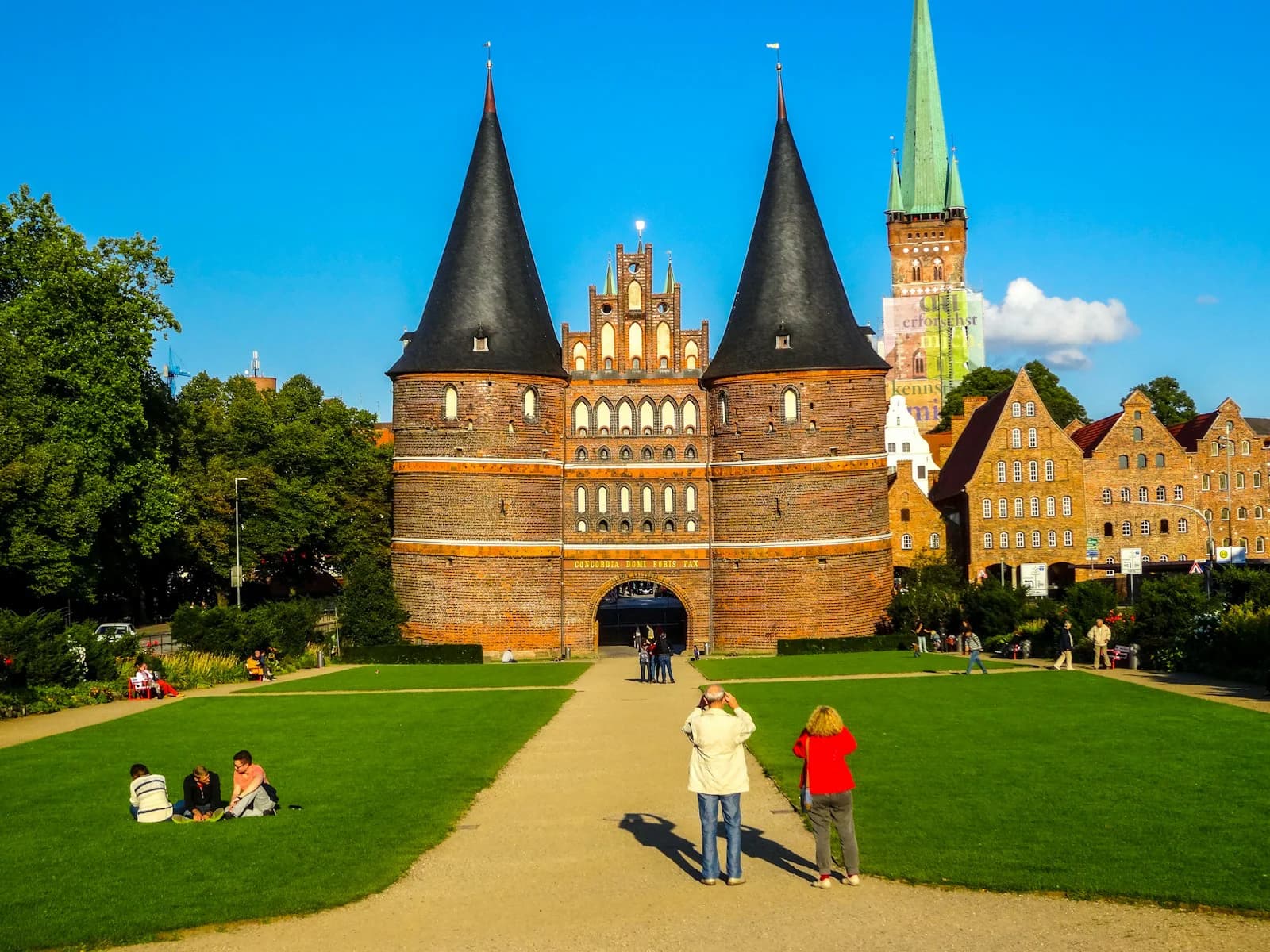
Lübeck's Burgtor stands at the northern end of the old town island, near Große Burgstraße, where the streets leading toward the Burgkloster quarter narrow beneath a tower of red brick. It is one of two surviving towered gates from the city's medieval fortifications, the other being the far more photographed Holstentor at the western edge of the old centre. Because the Burgtor has no blockbuster museum inside and no dramatic leaning silhouette, many visitors walk through it without realising how much of the city's defensive logic it explains. This guide covers what the gate is, what you can reasonably expect to see, and how to build a short walk around it.
The gate is generally described as a free outdoor landmark you pass on foot rather than a ticketed attraction, and one aggregator lists a suggested visiting time of two to four hours for the area around it. Before you plan a stop here, decide what you actually want: a five-minute look at a piece of Brick Gothic military architecture, or a half-day exploring the museums and memorials clustered around it. Use the organiser's pages to confirm current access rather than assuming interiors are open.
What the Burgtor Actually Is
The Burgtor was built in 1444 in late Gothic style, replacing an earlier fourteenth-century fortification on the same spot, and today it survives as one of two towered gates from Lübeck's medieval defences. It takes its name from the old castle that once stood higher above the Trave and was converted into the Burgkloster in 1227. As part of the Hanseatic city's surviving fabric, the gate belongs to the UNESCO World Heritage listing that covers Lübeck's old town. Think of it as a working piece of city infrastructure that happens to be beautifully built, not as a monument on a plinth.
Architecturally, the gate shows the hallmarks of northern German brick building: towers, a gate passage and several chambers and passages inside that once formed part of the defensive system. The fabric preserves layers from different construction phases, which is a useful reminder that gates were repeatedly adapted as weapons and tactics changed. That is also why the Burgtor reads differently from the Holstentor, even though both are lumped together in most city round-ups.
Burgtor Versus Holstentor: Which to See First
If you have only one gate in you, the Holstentor wins on pure spectacle: it marks the western boundary of the old centre, was built in 1464 in Brick Gothic style, and remains the city's emblem, reproduced on souvenirs and on Germany's two-euro coin. The Burgtor, by contrast, is the northern gate and the less famous of the two surviving towered gates, which means smaller crowds and a more contemplative look at the same architectural tradition. Choose the Holstentor if you want the postcard and the city-history museum inside it; choose the Burgtor if you want a quieter piece of the fortification line and a reason to explore the northern old town.
It helps to think of the two as different chapters rather than rivals. The Holstentor guarded the landward approach from the west and still dominates its square; the Burgtor controlled the northern edge toward the Trave and the castle quarter. Walking between them gives you a sense of how tightly the island was ringed, and how much of that ring has disappeared. If time is short, see the Holstentor first and treat the Burgtor as the reward for continuing north.
The Double Fortification Line and the Northern Edge
The most interesting thing about the Burgtor is not its size but its role: it served as the inner gate of a double fortification system protecting the Hanseatic city. That distinction explains the gate's position slightly inland from the water and its relationship to the towers and walls that once stood further out. Most quick descriptions of Lübeck's gates skip this entirely, leaving the impression that the Burgtor is simply a smaller Holstentor. In fact it was part of a layered defence in which an attacker who breached the outer line still faced a second gate.
Standing at the gate, look for how the street bends and narrows as it passes through, and how the surrounding buildings press close to the passage. That compression is the medieval city's geography doing its job, funnelling traffic and slowing anyone arriving with hostile intent. The gate marks the entrance to the old town on its northern side and functions as a natural landmark for visitors heading into the historic district from that direction. It is a good spot to pause and reorient before pushing deeper into the island.
Where It Is and How to Reach It
The gate stands on Große Burgstraße at the north end of the old town island, with a GPS position of roughly 53.87391, 10.69119 if you want to drop a pin before you arrive. It sits within easy walking distance of the Burgkloster, the Maria-Magdalenenkirche and the Marstall, and the European Hansemuseum is just beyond that cluster. Because the old town is compact and largely pedestrian, most visitors reach the Burgtor on foot rather than by any specific bus or tram. Plan your approach from the station or from the Holstentor rather than hunting for a dedicated stop.
If you are arriving by train, Lübeck Hauptbahnhof is a short walk from the old town, and the station itself is described as accessible, with ramps and spacious lifts. From there you can head west to the Holstentor or north-east toward the Burgtor quarter, depending on which gate you want first. Komoot lists several local walking and cycling routes that pass the Burgtor, including a loop from Lübeck Hauptbahnhof, which is a practical way to see it as part of a longer circuit. Check the route profiles before committing if you are travelling with a bike or limited mobility.
What You Can See from Outside, and What Is Not Confirmed
Treat the Burgtor primarily as an exterior landmark: the brick massing, the tower, the gate passage and the way the structure sits in the street are all visible without a ticket, and that is what most visitors come for. Whether the interior chambers are open for public viewing is not something the available sources confirm, and no official opening hours are published for the gate itself. One aggregator claims twenty-four-hour access, but that is third-party data rather than an organiser statement. If interior access matters to your visit, check the city's own cultural pages before you travel rather than relying on a listing site.
The same caution applies to any claim that the Burgtor houses a museum or charges admission. Nothing in the official material supports a paid interior attraction here, and the gate should not be confused with the Museum Holstentor, which genuinely does hold a city-history collection. If a booking platform offers you a Burgtor ticket, read the small print carefully, because you may be buying a tour or a nearby attraction rather than entry to the gate. Assume the gate itself is free to look at and plan your spending around the museums that are clearly ticketed.
Nearby Stops That Pair Naturally with the Gate
The Burgkloster lies close to the gate and is the obvious first companion stop, since the gate takes its name from the castle that became the monastery. A short walk away, the European Hansemuseum occupies the northern tip of the old town and covers the Hanseatic League in depth, which gives context to why a merchant city built gates like this in the first place. Note that these are separate ticketed sites with their own hours; buying one does not automatically include the other. Check each museum's own site for current admission before you go.
Right by the gate you will find smaller monuments and fragments that reward a slow look: the Maria-Magdalenenkirche, the Marstall, the Zöllnerhaus and several towers including the Burgtorturm and the Fleischerturm. Two lion figures, the Burgtorlöwen, stand nearby, and further along you reach the Burgtorfriedhof and the Ehrenfriedhof memorial cemetery, which the sources describe as a central memorial for civilian and military victims of both world wars, with around 1882 graves and roughly 500 memorial stones. These are outdoor, reflective places rather than attractions with queues. Treat them with the quiet they deserve.
A Short North-Old-Town Walk from the Gate
Start at the Burgtor and walk east and south into the old town rather than immediately heading back toward the station. This takes you past the Burgkloster and the Hansemuseum cluster, then continues through the quieter northern streets toward the market and the main churches. Allow a relaxed half-day if you want to look at the gate, the monastery buildings and one museum, or a brisk hour if you are only walking the route. Komoot lists a route of roughly eight kilometres linking the Heiligen-Geist-Hospital with the Burgtor for those who want a longer circuit.
End your walk near the Trave waterfront, where the river bends around the old town and the low light falls across the brick facades in the late afternoon. The northern edge is less crowded than the Holstentor side, which makes it a good place to slow down and look back at the skyline of spires. If you are still in an exploring mood, the Lübeck itinerary hub offers ways to stretch this into a full day. Keep the gate as the start of a walk rather than the destination itself, and the northern quarter will reward you.
Accessibility and Practical Logistics
One aggregator describes the Burgtor as wheelchair accessible, but this is not an official statement and the surrounding medieval streets vary in surface and width. Cobblestones, kerbs and narrow passages are common in this part of the old town, so treat the claim as a starting point rather than a guarantee. If step-free access is essential, contact the city's tourist information before you travel and ask about the specific approach you plan to use. Do not assume that accessibility at one gate implies the same at another.
For timing, the sensible approach is to anchor your visit to a nearby site that publishes its own hours, then see the gate on the way. The European Hansemuseum is open daily from ten until six and closed only on 24 December, so it makes an easy reference point for planning a northern-old-town morning or afternoon. If you prefer a guide, local operators and the tourist office run city walking tours, and those are the appropriate way to get commentary rather than expecting it at the gate. Verify all hours close to your travel date, since schedules change seasonally.
Who Should Prioritise the Burgtor, and Who Should Skip It
Prioritise the Burgtor if you are interested in medieval fortifications, if you want a quieter northern counterpart to the Holstentor, or if you are already visiting the Burgkloster and the Hansemuseum. It also suits anyone staying a second day in Lübeck and looking for a walk that is not the standard station-to-market route. Photography-minded visitors often prefer it precisely because the crowds are thinner and the light on the brick is softer in the afternoon.
Skip it, or at least do not build a day around it, if you have only a few hours and want the greatest hits. In that scenario the Holstentor, the Marienkirche and one museum will use your time better, and the Burgtor becomes a brief glance rather than a stop. The hidden gems in Lübeck guide is a useful companion if you want smaller, less obvious corners instead of headline sights. Decide based on how much you value atmosphere over checklist coverage.
Practical Tips and Combination Ideas
Wear shoes that handle uneven paving, because the old town's streets and the passages around the gate are not uniformly smooth. Carry a little cash for small cafés and museum counters, even though card acceptance is widespread in Germany. If you are visiting in winter, note that daylight fades early and the northern quarter is dimmer than the lit-up market area, so plan your gate stop before dusk. None of this is complicated, but it makes the difference between a comfortable wander and a rushed one.
For a longer stay, combine the Burgtor with the Holstentor and the surviving fragments of the fortification line to build a gate-and-wall theme across the city. You can also fold in the Marienkirche, whose brick Gothic design influenced churches across the region, if you want to compare sacred and military architecture on the same day. The Lübeck hub collects further itinerary options if you want a structured plan. A two-day stay gives you room to do the gates properly and still see the main churches and museums without rushing.
Plan Your Visit
The Burgtor rewards a specific kind of traveller: one who is willing to look at a gate as infrastructure rather than as a photo opportunity. It is free to see from the outside, quick to reach on foot from the northern old town, and best understood alongside the Burgkloster and the Hansemuseum that grew up around the same defensive line. Go expecting a quiet, layered piece of Brick Gothic masonry and you will not be disappointed.
Before you travel, confirm current access and any interior arrangements on the city's own culture pages, and check the opening hours of whichever museum you plan to pair with the gate. If accessibility is a factor, ask directly rather than trusting an aggregator listing. With those checks done, the Burgtor makes an easy, worthwhile addition to any Lübeck itinerary.
Frequently Asked Questions
Is the Burgtor free to visit?
The gate is treated as a free outdoor landmark that you pass on foot, and no official admission charge for entering the gate itself is published. That said, the interior chambers are not confirmed as publicly viewable, and no official opening hours for the gate are published either. If a booking platform tries to sell you a Burgtor ticket, check what it actually includes, because it may be a tour or admission to a nearby museum rather than entry to the gate.
Can you go inside the Burgtor in Lübeck?
The available sources do not confirm that the interior is open for public viewing, and the city does not publish visiting hours for the gate. One aggregator claims round-the-clock access, but that is third-party data rather than an official statement. Treat the Burgtor as an exterior landmark unless the city confirms otherwise, and check the official culture pages shortly before your trip if interior access is important to you.
How long do you need at the Burgtor?
For the gate alone, allow ten to twenty minutes to look at the structure, walk through the passage and read any on-site information. One aggregator suggests two to four hours for the wider area, which makes sense if you combine the gate with the Burgkloster, the European Hansemuseum and the surrounding memorial sites. Plan a half-day if you want to include a museum, and an hour if you are simply passing through on a longer old-town walk.
Is the Burgtor the same as the Holstentor?
No, they are two different surviving towered gates from Lübeck's medieval fortifications. The Holstentor marks the western edge of the old centre and now contains a city-history museum, while the Burgtor is the northern gate, dated to 1444, and is the quieter of the two. Seeing both gives a fuller picture of how the city was defended, and the Holstentor is usually the better first stop if you only have time for one.
What is there to see near the Burgtor?
Close by you have the Burgkloster, the European Hansemuseum, the Maria-Magdalenenkirche, the Marstall and several surviving towers and monuments, including the Burgtor lion figures. Further north lie the Burgtorfriedhof and the Ehrenfriedhof memorial cemetery, which the sources describe as a central memorial for civilian and military victims of both world wars. The museums have their own tickets and hours, so check each separately rather than assuming a shared admission.
Is the Burgtor wheelchair accessible?
One aggregator lists the Burgtor as wheelchair accessible, but this is not confirmed by an official source and the surrounding medieval streets have uneven surfaces, kerbs and narrow passages. If step-free access matters for your visit, contact Lübeck's tourist information before you travel and describe the specific route you intend to use. It is safer to verify directly than to rely on a listing site's general claim about the gate.
Sources
- 33 Sights in Lübeck, Germany (with Map and Images) | Visit Sights
- Burgtor in Lübeck Tickets [2026] - Promos, Prices, Reviews & Opening Hours | Trip.com
- Burgtor (Lübeck) – Wander- & Radrouten | Komoot
- Burgtor - Puerta medieval de la ciudad en Lübeck, Alemania
- Official event website
- LUBECK - a guide to Germany's most ravishing city | bye:myself
- Lübeck Hauptbahnhof, Lubeck, Germany - Reviews, Ratings, Tips and Why You Should Go – Wanderlog


