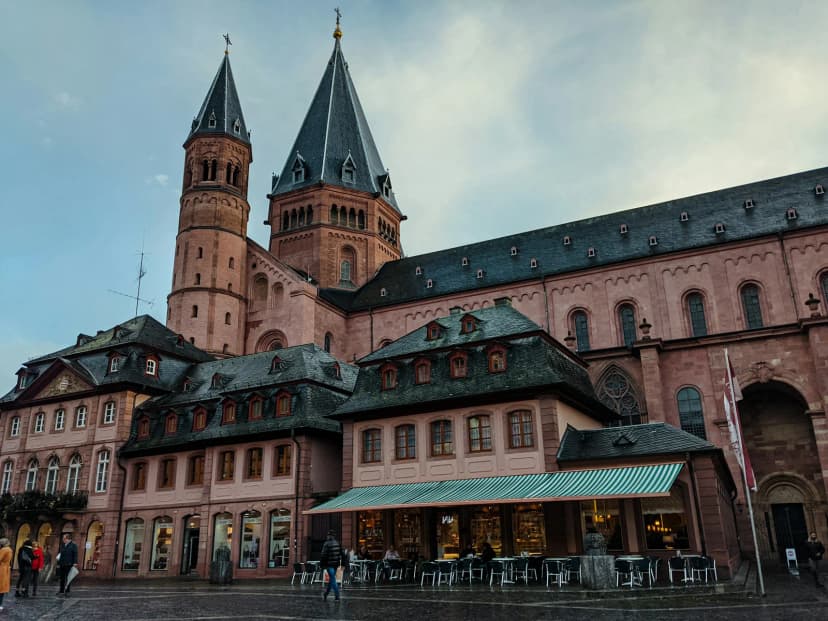
The Museum der bildenden Künste Leipzig, usually shortened to MdbK, stands at Katharinenstraße 10 in the pedestrian heart of the city. The most useful admission detail is the split: entry to the permanent exhibitions on the first and second floors has been free since the new municipal fee schedule came into force on 1 January 2024, and children and young people up to 18 also enter the special exhibitions free of charge.
Everything else follows a different logic, so decide before arrival which part of the museum you are visiting. If your interest is painting, graphic art and sculpture from the fifteenth through the nineteenth century, the free floors may be enough. If you came for whatever is currently on show, you will need the combined ticket for the basement and third-floor exhibition spaces.
Where the MdbK Actually Is
The operator address is Katharinenstraße 10, D-04109 Leipzig, in the shopping core a few minutes on foot from the Hauptbahnhof. There are two usable entrances, one on Katharinenstraße and a second via Böttchergäschen, and the operator describes both as accessible at ground level. Some older third-party write-ups still place the museum on Augustusplatz, but that is not the current operator address. Related guide: Leipzig: Landmark Visitor Guides.
Because the museum sits inside the pedestrian zone, arriving by train and walking is usually simpler than driving in. The operator notes that public transport stops are only a few minutes away without naming specific lines, so check the current network plan from the Leipzig transport operator on the day you travel rather than trusting an old guidebook's tram number.
Free Admission: What It Covers and What It Does Not
Free entry applies to the permanent exhibition titled Art 15th to 19th century, on the first and second floors. It does not extend automatically to the special exhibitions, which occupy the basement and the third floor and are sold together as one combined ticket. Children and young people up to 18 are exempt from the special-exhibition charge, so a family visit can cost less than the headline structure suggests.
Do not assume that one ticket opens every part of the building, or that a day pass covers the library, the exhibitions and the collection together. Tickets are sold at the museum's pay desk. If you only want the free floors, you can walk in, skip the ticket desk and spend your money on coffee instead. If a special exhibition is the reason for your trip, the combined ticket is your entry point, and the sensible route runs upward from the basement.
How the Ticket Structure Works
The operator prices section lists a regular and a reduced rate for the combined special-exhibition ticket, with the reduction granted on presentation of proof such as a student or trainee card, a Leipzig-Card, a Leipzig-Pass or a volunteer pass. Groups of ten or more pay a per-person group rate. An evening special ticket is sold in the final hour before closing at half the applicable rate, and an annual ticket is aimed at repeat visitors.
On the first Wednesday of each month the exhibitions are reduced to a low flat rate, which is the cheapest route in for anyone flexible on dates. Exact figures change, so confirm the current amounts on the operator's own page before setting a budget rather than relying on a reprinted table elsewhere. If you are combining several museums in Leipzig, remember that each venue sets its own admission rules.
Opening Hours, Closures and Choosing a Slot
The museum is closed on Mondays and opens Tuesday and Thursday to Sunday from 10 am to 6 pm, with a late Wednesday from 12 pm to 8 pm; on listed German and Saxon public holidays the hours match the weekend pattern. It closes on 24 and 31 December, and the operator's holiday list names Easter Monday, 1 May, Ascension Day, Whit Monday, the Day of Prayer and Repentance, 3 and 31 October, and 25 and 26 December.
A simple rule for choosing your slot: on a short city break, take the Wednesday late opening so the free collection can be combined with an evening walk through the arcades, and use a Leipzig on a rainy day guide if the weather turns. On a wet half-day, arrive when doors open, do the paid special exhibition while your concentration is fresh, then drift through the free floors as the building fills. If you are in Leipzig on a Monday, plan something else.
What Is in the Collection, and Why It Is Three Different Visits
The collection divides into paintings, graphic art and sculpture, and the displays rotate rather than sitting permanently fixed. The Sternburg Foundation is a distinct reason to come: the Leipzig merchant Maximilian Freiherr Speck von Sternburg assembled more than 200 paintings, numerous drawings, works of graphic art and a library on his estate at Lützschena near Leipzig, and the MdbK now preserves that group as a named holding.
The Evelyn Richter and Ursula Arnold Archive forms a third strand, run as a cooperation project between the Ostdeutsche Sparkassenstiftung and the museum. The works of the two photographers are preserved and researched at the MdbK and surfaced through exhibitions and publications rather than in a separate permanent gallery. Come for the painted collection, for the Sternburg holdings, or for photography, and check which of the three is on display during your dates instead of assuming all are visible at once.
Reading the Special Exhibition Programme
Special exhibitions are staged in the basement and on the third floor and change with the season, which is why the programme rather than the building is the variable worth checking. One example carried on the operator's own pages was Art Within Four Walls: Jewish Families and Their Collections in Leipzig, which ran from 30 September 2026 to 31 January 2027. Check the current listing before you travel and note the run dates, because nothing about future programming is guaranteed.
One planning consequence: if you are building a broader art itinerary, remember that the Spinnerei cluster on the city's western edge covers contemporary galleries and studios, a different proposition from the MdbK's historical collection. Splitting your time between the two gives you both the old-master and the contemporary angle without expecting either venue to do the other's job.
Free Things Families and Casual Visitors Often Miss
The MdbK Pocket Tour was developed for museum visits with children but can be used by anyone. It consists of a set of A5 cards, a clipboard and a bag with a mirror, pencil, hourglass and other objects for creative work, and the cards may be taken home after you return the rest at the ticket desk. On the studio terrace on the second floor, a free play-and-draw area with games, a puzzle, a reading corner and a drawing station is available during museum opening hours for all ages.
Several regular mediation formats are free and mostly need no registration, though participant numbers are capped. The Open Studio runs every Thursday from 3.30 pm to 6 pm for anyone aged 12 and over, blaumachen takes place on the first Wednesday from 3 pm to 7 pm, and a language tandem for German-speaking and German-learning women meets on the second Wednesday. The Generation 60+ dialogue tours run on the second Tuesday and the last Wednesday and are also free, while the separately listed guided tour in the exhibition programme is ticketed.
Weekend workshops for children follow their own schedule: emdebeka 4+ runs on the first Sunday morning and emdebeka 7+ on the second Sunday, each at a small flat cost, with topics announced in the calendar. Holiday workshops during the summer, autumn and winter school breaks require registration. Check the calendar for the week you are in town, because the formats rotate.
Accessibility and Inclusive Facilities
Both entrances, the Katharinenstraße and Böttchergäschen doors, are accessible at ground level, and all exhibition and service areas can be reached without steps, with automatically opening doors that carry contrasting markings. In the stairwells the museum uses tactile reliefs and Braille lettering as part of a universal-design guidance system, and accessible toilets are on the ground floor near the café and in the basement, reached by lift.
The honest caveat is that there is no floor guidance system, so visitors with visual impairments may still need assistance between rooms. A wheelchair and portable stools can be borrowed free of charge, and assistance dogs are welcome. The inclusive information stations known as MdbK hubs offer tactile reliefs, audio texts in easy language and videos in German sign language, and some public tours and opening speeches are interpreted in sign language.
Eating, Resting and the Free Outdoor Installation
The museum bistro MOKAAWE keeps hours that differ from the museum's, so do not assume you can eat whenever the galleries are open. It serves Tuesday and Thursday to Sunday from 9 am to 7 pm, Wednesday from 9 am to 9 pm, and public holidays from 9 am to 7 pm, with speciality coffee, a changing food menu and homemade cakes, shifting to a wine-focused evening. Confirm these hours for your date rather than reading them off the museum timetable.
Inside the collection, the soft seating sculptures called Softie Hills by Alexandra Börner are made to be touched, sat on and even lain on, which makes them a useful pause point for tired legs and restless children. Outside the building, the Museum Square between the MdbK and Katharinenstraße holds Nina Schuiki's 125-metre installation Spring, which is publicly accessible around the clock. That outdoor access does not mean the museum itself is open at night, so keep the two ideas separate.
Practical Visit Plans by Time Budget
With roughly an hour, stay on the free floors, take one room at a time and skip the special exhibition entirely. This is the honest option if you are squeezing the museum between other stops, such as a visit to the Bach-Museum Leipzig or a walk around the old town. Allow around 90 minutes to two hours if you want to read labels properly and sit down at least once.
For a half-day, add one ticketed special exhibition and the pocket tour, then finish on the studio terrace or in the bistro. That combination suits a rainy afternoon and comfortably fills two to three hours. If you want a longer, slower visit, layer in a guided tour, a workshop and a meal, and plan it as an afternoon rather than a stop.
As a personal suggestion, not an official figure, budget about one and a half to two hours for the free floors and two to three hours if you add a special exhibition. Any visit that includes a workshop, a guided tour or a meal at MOKAAWE will run longer. If you are pairing two indoor stops on the same day, put the MdbK first while your attention is sharp.
Booking, Groups and the Library
Guided tours and group visits are arranged through the visitor service, and the published tour fee covers a set length of one and a half hours with a maximum of 20 people. Self-guided class visits are also possible but must be booked at least a week in advance. For school and education groups, the art mediation team handles advice and registration during limited weekday phone hours, so sort your booking early rather than on arrival.
The museum library keeps its own hours, opening Wednesday afternoon and otherwise by appointment, and it publishes closure windows that do not match the museum's opening pattern. If a book or print room is central to your reason for travelling, confirm dates with the library before booking anything else. The same principle applies to the museum shop: the operator has advertised for an experienced operator to run a new shop, with a stated application deadline, so treat the shop as a future project rather than an existing facility.
Plan Your Visit Around the Right Ticket
The single most useful habit with the MdbK is to decide before you arrive whether you are there for the free permanent collection on the first and second floors or for the separately ticketed exhibitions in the basement and on the third floor. Free access to the collection has applied on the operator's own pages since 1 January 2024 under the municipal fee schedule, and children up to 18 also enter the special exhibitions without charge. Everything else, from prices to the dates of the current show, is published on the museum's website.
If the museum is one item in a wider trip, pair it with an evening walk through the arcades or a second indoor stop, and use a city itinerary to sequence the day rather than stacking three museums back to back. The venue rewards a little preparation and punishes assumptions about one all-inclusive ticket. For wider planning, see Leipzig city travel guides.
Frequently Asked Questions
Is the Museum der bildenden Künste Leipzig free to enter?
The permanent exhibition of art from the 15th to the 19th century on the first and second floors is free, under the municipal fee schedule that came into force on 1 January 2024. Visitors aged up to 18 also enter the special exhibitions without charge. The special exhibitions themselves, in the basement and on the third floor, normally require the combined ticket, so the museum is not free for every visitor on every occasion. Check the operator's information page for the current arrangement rather than assuming it stays unchanged.
How long should I allow for the Museum der bildenden Künste?
As a suggestion rather than an official figure, allow about 90 minutes to two hours for the free collection floors if you want to read labels and take a break. Adding one special exhibition pushes that to roughly two to three hours, and a workshop or guided tour will extend it further. If you are short on time, one hour on the free floors is still worthwhile. The museum does not publish a prescribed visiting time.
Where exactly is the museum, and is it on Augustusplatz?
The address is Katharinenstraße 10 in the Leipzig pedestrian centre, a few minutes on foot from the Hauptbahnhof, with a second entrance through Böttchergäschen. Older third-party descriptions that place the museum on Augustusplatz are outdated. Both entrances are accessible at ground level, and the operator notes that public transport stops are a short walk away without listing specific lines, so check the current network plan locally.
Can I visit with children, and is there anything to do that does not cost extra?
Yes. The pocket tour, borrowed at the ticket desk, was designed for visits with children and can be used by anyone, and the cards may be kept after returning the rest of the kit. The studio terrace on the second floor offers games, a puzzle, a drawing station and a reading corner free during museum opening hours. Free weekly formats include the Thursday Open Studio and blaumachen on the first Wednesday, while weekend children's workshops and holiday workshops carry a small charge and, in the case of holiday programmes, require registration.