
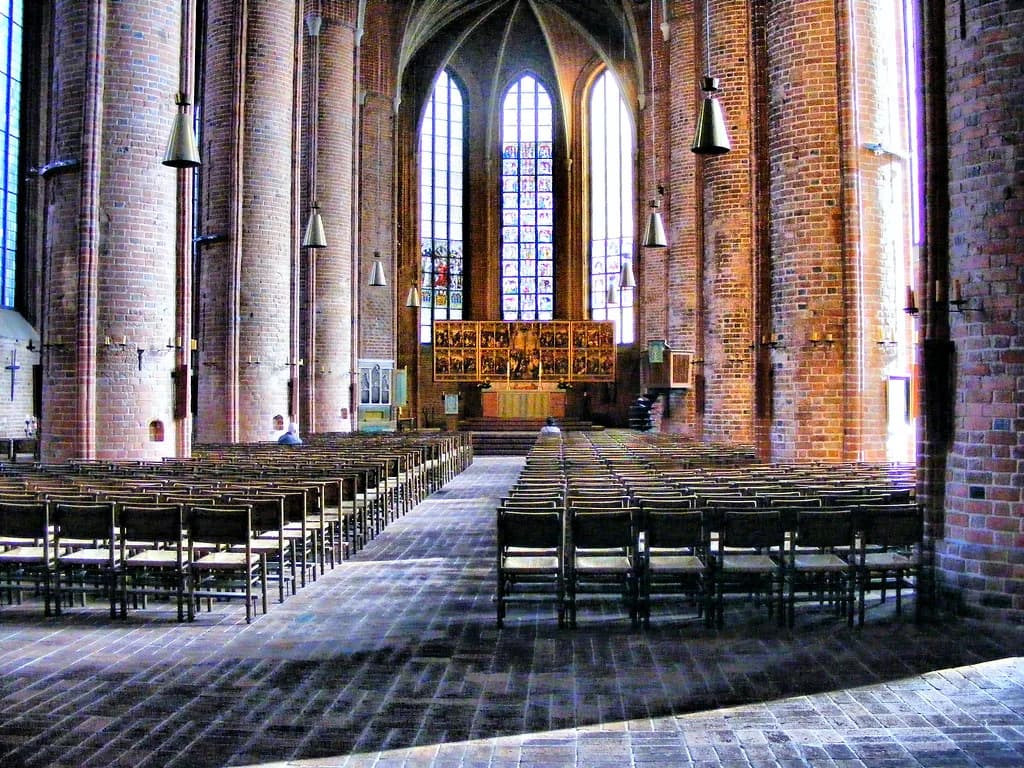
The Marktkirche, officially St. Georgii et Jacobi, is the building that gives Hanover's old town its silhouette. It is a three-nave hall church in North German brick Gothic style, and its 97-metre tower makes it one of the city's landmarks. The operator's site notes that a house of worship has stood here for nearly 900 years and that the Gothic hall church itself is 650 years old.
One concrete detail to start with: the pentagram on the outer facade. The tourism listing calls it a special architectural feature whose meaning remains a mystery to this day. That is the level of certainty you get — a puzzle, not a legend with a tidy answer.
Where the Marktkirche Sits in Hanover's Old Town
The address is Hanns-Lilje-Platz 2, in the heart of the old town. The Old Town Hall, the market square and numerous cafes and shops sit in the immediate vicinity, so you will not need to plan a separate trip. The tourism listing says the church is easily accessible by public transport or on foot, without specifying routes or journey times.
Because the church is embedded in the old town rather than set apart, the practical move is to treat it as one stop on a walking sequence. The visit-hannover page places Kröpcke, the square with the clock and the subway hub, as another central reference point. Between those two anchors you can orient yourself without guessing at tram lines or journey times.
Brick Gothic Explained: Hall Church, Tower and Pentagram
Brick Gothic describes a building tradition that used brick as the main material, and the Marktkirche is described by the tourism listing as an outstanding example of North German brick Gothic architecture. A hall church means the nave and side aisles are roughly the same height, so the interior reads as one wide room rather than a tall central corridor with lower flanks. That is why the space feels broad when you step in.
The tower reaches 97 metres and dominates the old town skyline, per the tourism listing. The visit-hannover page adds a construction anecdote: when the tower had reached only half its intended height, the city's empty coffers ended the planned ascent, and a shorter spire was added for financial reasons. That design apparently proved popular enough to inspire imitators. The same tourism listing describes the pentagram on the outer facade as a detail whose meaning remains unexplained.
A Short History You Actually Need
First mentioned in 1238, the present church was built in the 14th century on the site of a Romanesque predecessor. The tourism listing states that it was badly damaged during the Second World War and faithfully rebuilt between 1946 and 1952 under the direction of architect Dieter Oesterlen. The visit-hannover page summarises the same arc more briefly, noting a 1952 rebuild in the historic style. Those two formulations are compatible: the rebuilding programme ran across several years and was completed in 1952.
The church's own site frames the timeline in centuries rather than exact years, saying a house of worship has stood here for nearly 900 years and the Gothic hall church for 650. That is a useful reminder to treat any single date as approximate context. The postwar rebuilding is the part that most directly explains what you see today.
Interior Highlights: High Altar, Stained Glass and Goll Organ
Three fixed points structure the interior. The tourism listing notes the late Gothic high altar from the 15th century and stained glass windows with scenes from the lives of the patron saints George and James. It also notes that organ music here attracts visitors from all over the world, and the church's own programme refers to the instrument as the Goll organ.
One grave is easy to walk past. The visit-hannover page states that Johann Michael von Obentraut, nicknamed the German Michel, is buried in the Marktkirche. He fought in the Thirty Years' War at the head of a German-Danish army against General Tilly and was mortally wounded on 25 October 1625. The same page notes that even well-informed Hanoverians are often surprised by this.
On the outside, the visit-hannover page states that the west portal was designed by sculptor Gerhard Marcks and features motifs from the saddest chapter in German history. It is worth stepping back to look at it before you enter, because you will not see it from inside. Between the portal, the altar and the windows, the building rewards a slow loop rather than a quick walk-through.
Is the Church Free to Enter?
The sources here do not state an entry fee for the church, and they also do not guarantee free admission, so this guide will not claim either. What is documented is that the Marktkirche regularly hosts concerts, exhibitions and lectures, and those are separate events. The church's own site, for example, advertised advance online sales for a Bachchor performance of Britten's War Requiem.
The practical distinction: attending a ticketed concert is not the same as visiting the church as a sightseer. If you want to know whether entry is charged on the day you plan to go, check the operator's site or ask at the Tourist Information office in Hanover. Do not assume a concert ticket substitutes for a normal visit, or vice versa.
Opening Hours: Why the Two Published Sets Differ
The operator's site lists Monday to Friday 10:00–18:00, Saturday 10:00–17:00, and Sunday 09:30–18:00. The tourism listing shows 10:00–18:00 every day of the week, including Saturday and Sunday. Both were published on the pages those organisations control, and they do not match for the weekend. That is why this guide treats the hours as a starting point rather than a fixed fact.
The operator states plainly that sightseeing may be limited during services and events and points visitors to its calendar. A morning service, a midday prayer or an evening concert can restrict access to the nave even inside the published hours. That caveat matters more than which of the two weekend schedules is correct on paper.
So the correct method is: check the operator's calendar for the specific day, then confirm the hannover.de tourism page if you want a second view. Treat published hours as a window rather than a promise. If the church is the main reason for your trip, that check takes a couple of minutes and saves a wasted detour.
Music and Culture: What the Concert Programme Means for Visitors
The Marktkirche functions as a civic venue as much as a parish church. The tourism listing records that concerts, exhibitions and lectures are held regularly, and that the organ music attracts visitors from all over the world. That dual role is why the space can feel very different on a Saturday evening than on a quiet weekday morning.
The church's own site posts its music programme with specific dates; recent listings included Saturday evening organ recitals and a Bachchor performance of Britten's War Requiem with advance sales online. Those dates were tied to the site's own publication, so check the current calendar rather than relying on any older schedule. What matters for planning is the pattern: Saturday evenings and special weekends are when sightseeing is most likely to be interrupted.
Tower Access: What the Sources Do and Do Not Say
The tower is 97 metres tall and dominates the skyline — that part is well documented by the tourism listing. What is not documented in these sources is whether you can climb it. There is no stated tower access, no tower hours, no ticket requirement and no safety or lift information.
If a tower visit matters to you, ask the operator directly or check the church's contact pages. Do not treat the tower's status as a landmark as evidence that it is open for climbing. A documented alternative for a high view is the New Town Hall dome, which the city tourism site promotes separately with its own lift.
Pairing the Marktkirche with the Old Town Hall, Marktplatz and Red Thread
The Old Town Hall sits right next to the church, along with the market square and a cluster of cafes. The city tourism site promotes the Red Thread, a painted route through the old town, as a way to walk the centre. If you are working through a Hanover old town walk, the Marktkirche is one of the natural fixed points on it.
The city tourism site also lists a Hop-on Hop-off city tour with an audio guide that reaches the main sights flexibly, which is a reasonable option if your time in Hanover is short. If you would rather not pay for a tour, a free-things-to-do approach to Hanover covers the old town on foot at no cost beyond what you choose to spend. Either way, the church and the square are the same stop.
Suggested Duration and a Half-Day Old Town Sequence
For the church alone, allow roughly 30 to 45 minutes if you want to read the altar, find the German Michel grave and look at the stained glass properly. This is a suggested budget, not an official figure — the sources do not publish a recommended visit length. Add time if a service or a concert is in progress and access is limited.
For a fuller half day, start at the Marktkirche, walk the market square and the Old Town Hall, then follow the Red Thread through the old town. If you have longer, the Berggarten Hannover botanical garden is a different kind of stop for a second day. If you are building a city itinerary rather than a single visit, the city guide section is the better place to sequence days.
What to Check Before You Go
Before you set out, verify two things on the operator's site: the hours for your specific day and whether a service or event will restrict sightseeing. Those two checks resolve the gap between the published schedules and the reality on the ground. The church's calendar is the single most reliable place to look.
If your main goal is architecture, the brick Gothic fabric, the Marcks west portal and the high altar justify the trip on their own. If your main goal is a view, confirm tower access directly before assuming anything, and consider the New Town Hall dome as a documented alternative. Either way, the Marktkirche anchors Hanover's old town and works best as part of a walk rather than a drive-by.
Frequently Asked Questions
Is the Marktkirche in Hanover free to visit?
The sources do not state an entry fee for the church, and they also do not guarantee free admission, so this guide will not claim either. What the tourism listing does confirm is that concerts, exhibitions and lectures are held here, and those are separate events with their own arrangements. To find out what applies on your date, check the operator's site or ask at the Tourist Information office in Hanover.
What are the Marktkirche opening hours in Hanover?
The operator's site and the tourism listing give different weekend times: the operator lists Monday to Friday 10:00–18:00, Saturday 10:00–17:00 and Sunday 09:30–18:00, while the tourism listing shows 10:00–18:00 every day. Because services and events can also restrict sightseeing inside published hours, the operator's calendar is the better single source. Check it for your specific date rather than trusting one fixed number.
Can you climb the Marktkirche tower?
The sources confirm the tower is 97 metres tall and a landmark of the old town, but they do not establish tower access, tower hours, ticket requirements, lift access or safety rules. Because those details are not published, this guide cannot say whether climbing is possible. If a tower visit is important to you, contact the church directly before you travel, and consider the New Town Hall dome as a documented alternative for a high view.
What should I see inside the Marktkirche?
Prioritise four things: the late Gothic high altar from the 15th century, the stained glass windows with scenes from the lives of the patron saints George and James, the Goll organ, and the grave of Johann Michael von Obentraut, known as the German Michel. The west portal by sculptor Gerhard Marcks is on the outside, so look at it before you go in. A slow loop takes roughly half an hour to forty-five minutes.
How long does a visit to the Marktkirche take?
As a suggestion rather than an official figure, allow about 30 to 45 minutes for the church alone if you want to read the altar, find the German Michel grave and study the stained glass. Add time if a service or event is underway, because the operator notes that sightseeing may be limited then. For a half day, combine the church with the market square, the Old Town Hall and the Red Thread route through the old town.


