
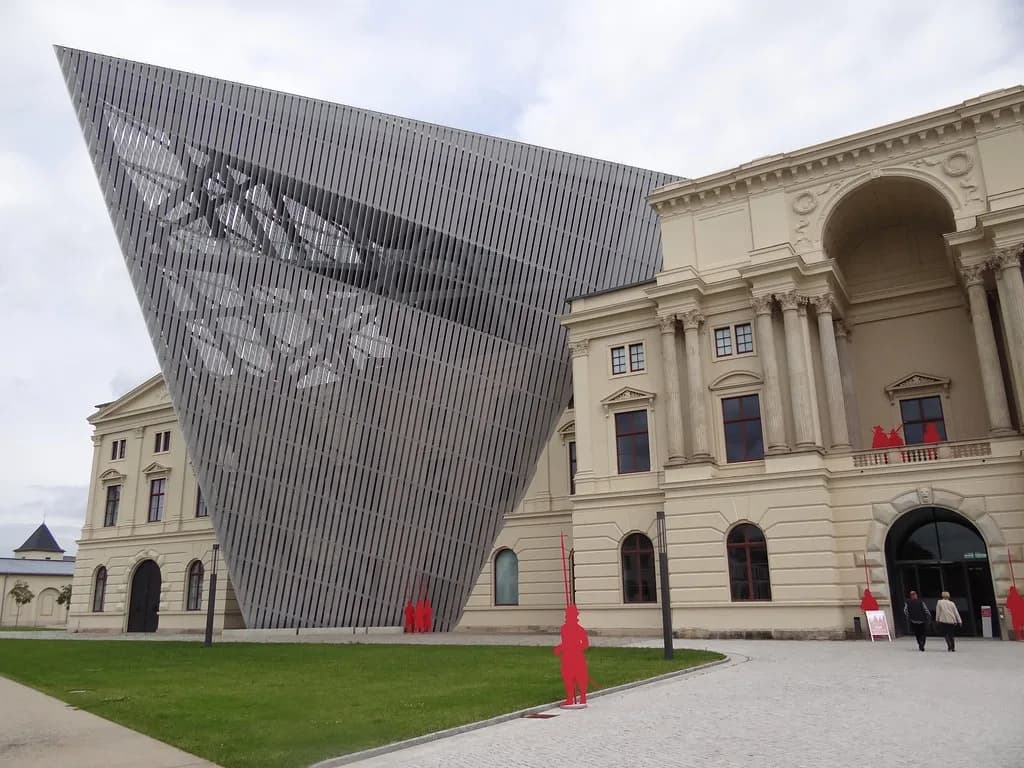
Dresden's Military History Museum is run by the German armed forces, not by the city, so it sits outside the municipal museum network and its shared admission rules. That distinction matters before you go: you are planning around a Bundeswehr institution rather than a stop on a Dresden museum pass. The address is Olbrichtplatz 2 in the Albertstadt district, north of the historic centre.
The operator publishes opening hours, admission fees and directions on its plan-your-visit page, and those are the figures worth checking the day before you travel. Adult admission, concession rates, family tickets and an annual pass are listed as separate rows, with the permanent exhibition, the special exhibition and a combined ticket priced individually rather than as one flat fee.
What makes this museum unusual is not the hardware. It is the way the collection is deliberately split between the old arsenal building and Daniel Libeskind's metal wedge, producing two very different routes through one admission. Budget for more time than a conventional army museum demands.
Why This Museum Is Not a Traditional Army Museum
Most military museums organize themselves around victories, uniforms and technology. This one was explicitly reconceived as the central museum of the Bundeswehr, and its approach is broader and more critical, examining war's social, cultural and human costs rather than celebrating equipment. Displays address pain, suffering and death directly, which visitors expecting a parade of tanks sometimes find confronting.
The building's own history mirrors Germany's: it began as an armoury in the Albertstadt complex, later served as the Saxon Army Museum, then as a Nazi military museum and subsequently as a Soviet and East German institution. Studio Libeskind records those shifting identities as part of the project's rationale, noting the building was closed before an international competition reopened its future.
If your image of a war museum is rows of medals and cannons, adjust expectations before you buy a ticket. The collection does include large weaponry, including a V2 rocket standing upright through several floors, but it is embedded in an argument about what militarization does to societies and to individuals.
Ticket Scopes: Permanent, Special, Combined and Annual Pass
The admission structure is the single most misunderstood part of planning a visit. The permanent exhibition and the special exhibition each carry their own adult, group and family rates, and a combined ticket covers both at a higher figure than either alone. Because these are listed as separate rows, do not assume one purchase gets you everywhere.
Concessions are a distinct category, applying to groups such as students, trainees, apprentices, recipients of certain benefits and people with recognized severe disability, and proof is required at the desk. Family tickets are priced for two adults with at least one child under 18, while school and youth groups have their own arrangements. Check which row applies to you rather than assuming a single reduced rate.
An annual pass exists as a separate product with its own concession price, covering all exhibitions at the Dresden site. The operator states it is non-transferable and valid only together with photo identification, and that at weekends one additional person may enter free. Tickets in general are valid only on the day of purchase, so a combined ticket bought on Monday will not carry into another day.
Card and cash payment are both accepted at the ticket desk, with American Express excluded, and gift vouchers and books are also sold there. Because fees and opening times are volatile, confirm the current schedule on the operator's page shortly before your visit rather than relying on a printed guide or an older article.
What Is Free and What Requires a Ticket
Free admission is not a general policy here; it is a defined list. The operator grants free entry to children and young people up to and including the age of 18, to school students aged 18 and over visiting as part of an organized school group, and to participants in programmes such as the Federal Volunteer Service and the voluntary social and ecological years.
Several professional and service categories are also exempt, including civilian and military personnel of the Bundeswehr, reservists with valid identification, former service personnel with a recognized service-related disability, members of NATO armed forces, ICOM and German Museum Association members, accredited media representatives, and recipients of benefits under the Asylum Seekers Benefits Act. One accompanying person may enter free where this is indicated on proof of disability. All of these require proof, so bring documentation.
Do not confuse this with the Museums of the City of Dresden. Their published fee scheme covers municipal sites such as the Dresden City Museum and the Municipal Gallery, and it does not include the Bundeswehr museum. A Dresden Pass or a Friday free-admission window at a city museum therefore has no bearing on this ticket desk.
The Building: Historic Arsenal Meets Libeskind's Wedge
The most striking thing about arriving here is not the collection but the collision of two architectures. Libeskind's extension takes the form of a massive five-story wedge of glass, concrete and steel that cuts into and through the classical symmetry of the former arsenal, deliberately interrupting the historic facade rather than sitting politely beside it.
The architect's project description frames this contrast in terms of meaning: the opacity and rigidity of the old building stands for an authoritarian past, while the transparency of the new structure is intended to suggest a military operating within a democratic society. Whether or not you accept that reading, the visual deconstruction is the reason many visitors come even without a strong interest in military history.
Be careful with the numbers attached to the design. The wedge tonnage, the building and exhibition floor areas and the height of the viewing platform all come from the architect's published project data and describe the design, not facilities you can plan a visit around. Treat the viewing platform as an architectural feature, not a booked attraction with guaranteed access.
The building sits in Albertstadt, a district shaped by the nineteenth-century barracks and arsenal complex that once surrounded it. That setting explains why the museum feels removed from the baroque old town, and why the forecourt and open spaces around the wedge were treated as part of the design rather than leftover ground.
How the Chronological and Thematic Halves Differ
The permanent exhibition is effectively two museums in one building. The older parts of the arsenal hold a largely chronological sequence, with the ground floor covering the period up to the First World War and the upper floor carrying the story from 1914 through the world wars into the present day. That half rewards anyone who wants a structured timeline.
The wedge half abandons chronology for themes, each pairing war with another aspect of life, such as memory, music, fashion, language, play or suffering. Thematically organized galleries like these tend to sit less comfortably in a straight line, so expect to move back and forth rather than follow a narrative from start to finish.
One practical consequence is that the two halves suit different moods. The chronological route is easier to walk when tired because the sequence carries you forward, while the thematic route demands more attention per display case. If you only have a short window, decide in advance which half matters more to you.
Highlights Worth Seeking Out Across Both Halves
Two objects dominate the wedge's central void and are hard to miss. A complete V2 rocket stands upright and extends through several floors, so you encounter it from different levels, while a Soyuz capsule associated with Sigmund Jähn, Germany's first person in space, hangs nearby. Both anchor the thematic route's argument about technology and its consequences.
Smaller objects often land harder. A partly melted toy tank recovered from Dresden's rubble after the February 1945 firestorms sits within a section on war and play, and deformed items from Hiroshima appear in the sections dealing with suffering. A display built from shoes associated with concentration camp victims brings the Holocaust into the chronological half.
The post-1945 galleries are where the museum diverges most from foreign equivalents, tracing the parallel stories of East and West Germany, the National People's Army, socialist-era propaganda, NATO integration and a segment of the Berlin Wall. Because temporary exhibitions rotate, treat any specific show you read about as changeable and check what is currently on display before you go.
How Much Time to Allow and How to Pace the Visit
Our own suggestion, not an official museum recommendation, is to allow roughly two and a half to three hours if you want to see both halves with any care, and closer to four if you read labels consistently. Anyone with a specialist interest in twentieth-century German history should treat half a day as a realistic minimum rather than an indulgence.
Pacing depends on direction. In the wedge, the layout funnels visitors upward first and then downward through the themed levels, which means the descent sets the rhythm and a slow start upstairs can leave you rushing at the end. Starting with the older chronological building instead lets you break up the more demanding thematic route with a pause.
Last admission is thirty minutes before closing, so a late arrival truncates the visit sharply. Note also that the museum publishes Monday as a long day, with shorter hours on Tuesday and a weekly closing day midweek, meaning a Monday evening and a Sunday afternoon feel like entirely different visits. Confirm the current schedule rather than planning from memory.
Snacks, hot drinks and cold drinks come from vending machines in the foyer rather than a full cafe, so a sit-down meal is better planned before or after. If rain pushes you indoors for the afternoon, this is a strong candidate, though it fills a large block of the day rather than an hour.
Getting There and Practical Visiting Notes
Public transport is straightforward: tram lines 7 and 8 and bus route 64 serve the stop named for Stauffenbergallee and the Military History Museum. Dresden-Neustadt railway station is three kilometres from the museum according to the operator, which is walkable for some visitors but better done by tram with bags or in bad weather.
Drivers arriving via the A4 use the Dresden-Hellerau exit, and free parking is available on the museum grounds. That is a meaningful advantage over the old town, where parking is scarce and expensive, and it makes the museum a reasonable first or last stop if you are arriving by car.
The museum offers a varied programme of guided tours, and group visits can be registered through visitor services in advance. If you want a tour, check availability early, since guided formats often run at fixed times and fill independently of general admission. The library requires advance registration because reading-room places are limited.
Because the operator has not published details in the sources reviewed here about step-free routes, lifts or other accessibility arrangements, ask visitor services directly about your specific needs rather than assuming. Visitor regulations are also published separately, and they govern conduct inside the galleries.
Common Mistakes First-Time Visitors Make
The most frequent error is assuming a single ticket covers everything. Permanent and special exhibitions are scoped and priced separately, and the combined ticket is a distinct product, so decide which you want before reaching the desk. Buying the cheaper option and then upgrading mid-visit wastes time you could spend in the galleries.
A second mistake is expecting a free-admission day as at some municipal museums in the city. Free entry here is tied to defined categories such as age, school groups, Bundeswehr personnel and specific membership or benefit status, not to particular weekdays. Bring proof if you think you qualify.
A third is treating the architecture as a five-minute photo stop. The wedge shapes the whole exhibition experience, including how you move through it, so visitors who skip straight to the hardware miss the point of the design. Finally, do not plan this museum and a second major Dresden collection back to back; the thematic route alone can exhaust a full afternoon.
Planning Your Dresden Museum Day
The Military History Museum rewards a deliberate plan. Decide whether you want the permanent exhibition, the special exhibition or both, check the current hours and fees on the operator's page in the days before you travel, and give yourself enough time that the thematic route in the wedge is not squeezed into the last hour before closing. For a different kind of indoor visit, compare this with our Panometer visitor guide.
Albertstadt is north of the historic centre, so pair the museum with Neustadt rather than trying to slot it between old-town sights. Trams 7 and 8 and bus 64 make that connection simple, and free on-site parking helps if you are driving in from outside the city.
Frequently Asked Questions
How long should I spend at the Military History Museum in Dresden?
As a rough suggestion rather than any official recommendation, allow about two and a half to three hours to cover both the chronological and thematic halves at a reasonable pace, and up to four hours if you read most labels. Because last admission falls thirty minutes before closing, a late start cuts the visit short. If twentieth-century German history is your main interest, half a day is more realistic.
Do I need a separate ticket for the special exhibition?
The permanent exhibition and the special exhibition are scoped as separate admission products, and a combined ticket exists that covers both. That means the cheapest single-exhibition option will not let you into the other half. Check the operator's plan-your-visit page for the current structure before deciding which to buy, since the rows are listed independently.
Is the Military History Museum free to enter?
Not in general. Free admission applies to defined categories, including children and young people up to and including 18, students over 18 visiting as part of an organized school group, Bundeswehr personnel and reservists with valid identification, members of ICOM and the German Museum Association, and recipients of certain benefits. Proof is required, and the free-entry provisions of Dresden's municipal museums do not apply here because this is a Bundeswehr institution.
What is the difference between the chronological and thematic exhibitions?
The older arsenal building holds a largely chronological sequence running from the medieval period through the world wars to the present, which suits anyone who wants a timeline. The Libeskind wedge instead organizes galleries around themes that pair war with other areas of life, such as memory, music, fashion, language and suffering. The two halves feel quite different, so decide which to prioritise if your time is limited.
Can I visit just the Libeskind architecture?
The wedge is integral to the building rather than a separately ticketed attraction, and the themed galleries occupy it, so you cannot buy architecture-only admission. You can, however, appreciate the exterior and forecourt freely while the interiors require a ticket. Whether the viewing platform is accessible during your visit is not something the published sources confirm, so ask visitor services on arrival.
How do I get to the museum by public transport?
The operator lists tram lines 7 and 8 and bus route 64 serving the Stauffenbergallee and Military History Museum stop. Dresden-Neustadt railway station is three kilometres away according to the same source, which is a short tram ride or a longer walk. Drivers can use the A4 Dresden-Hellerau exit and park free on the museum grounds.


