Last updated September 2026, this guide is for anyone searching for the hidden gem church in Manchester: St Mary's Catholic Church on Mulberry Street. Office blocks and retail units now hide its brick exterior from Deansgate, which is most of the reason for the nickname. Inside, Victorian carving sits next to a 1994 set of expressionist Stations of the Cross by Norman Adams.
Why Is St Mary's Catholic Church the Hidden Gem in Manchester?
Bishop Herbert Vaughan visited the parish in 1872 and told the congregation, 'No matter on what side of the church you look, you behold a hidden gem.' That line stuck long after his visit ended. Mulberry Street actually opened onto a busy stretch of Deansgate back in the 1790s, so the building was never designed to hide. Office blocks and retail units now surround the plot at 17 Mulberry Street, Manchester M2 6LN. From the pavement, the entrance looks like a gap between two buildings, not a landmark. Twentieth-century redevelopment around Deansgate added most of that cover, one office block at a time. Even longtime Manchester residents sometimes need directions the first time they try to find it. By the time most visitors go looking for St Mary's today, the nickname fits far better than it did in 1872. Guides to Manchester's tucked-away courtyards and back-street landmarks usually put St Mary's near the top of the list for exactly this reason.
From 1794 to the 1835 Roof Collapse
Manchester's first post-Reformation Catholic mass center was a separate chapel dedicated to St Chad, which opened on Rook Street in 1774 and burned down in 1846. Father Rowland Broomhead set up a second Manchester chapel in the mid-1790s, buying a plot near Deansgate for the purpose. That chapel opened on Mulberry Street on 30 November 1794, dedicated to St Mary, Our Lady of the Assumption. Manchester's Catholic population grew quickly during the Industrial Revolution, as Irish families arrived to work in the cotton trade. Trouble started on 8 August 1835, when a crack opened in the dome above the altar. By 11pm that night, the dome and part of the roof had collapsed, wrecking much of the interior. Congregation-led repairs, carried out without a professional builder, are usually blamed for the failure. Services moved temporarily to Lloyd Street while the parish searched for a permanent solution. Father Henry Gillow, the rector at the time, died in Manchester's 1837 typhus epidemic before a rebuild could begin. St Mary's is the oldest post-Reformation Catholic church in Manchester, a status that survived both the collapse and the rebuild that followed. The parish now falls under the Roman Catholic Diocese of Salford, within the St Ambrose Barlow deanery covering south Manchester.
Rebuilding St Mary's: Architecture and Interior Highlights
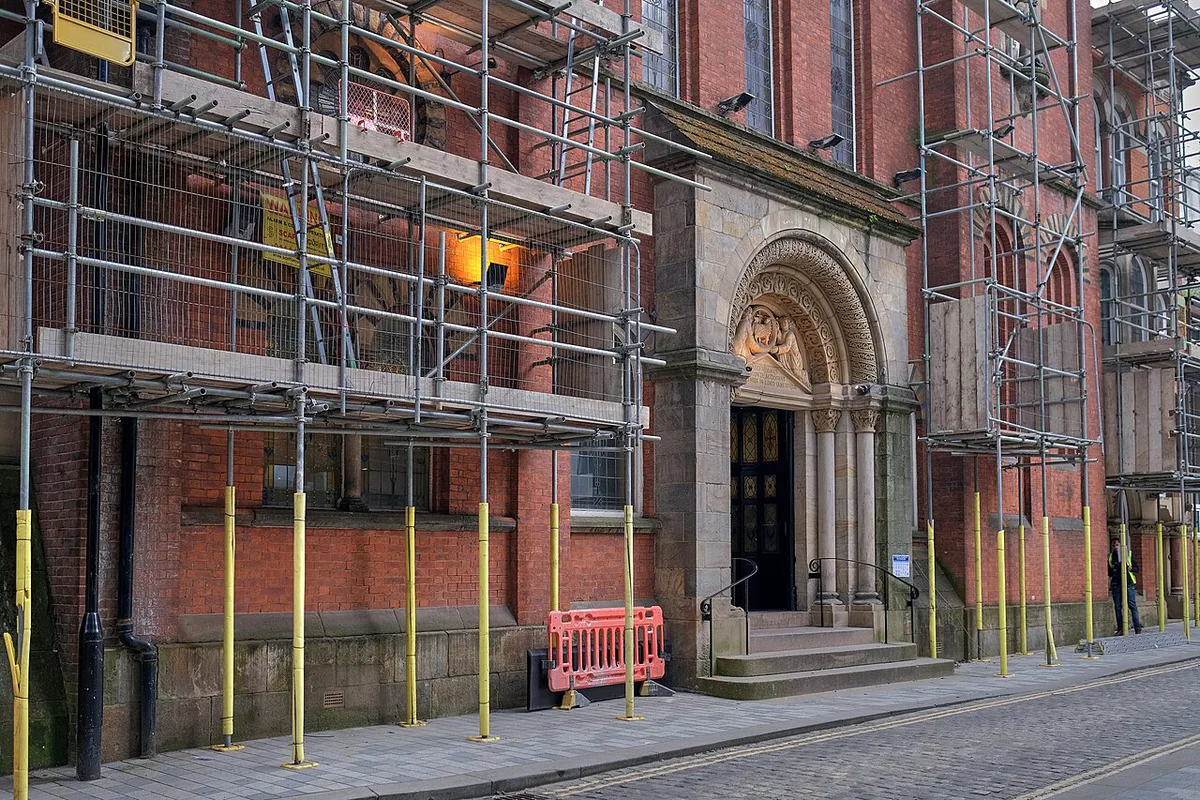
Two architects submitted designs for the new church: Richard Lane, who had already built Salford Town Hall and the Friends Meeting House, and Augustus Pugin. Lane's design was chosen, at a noticeably higher cost than Pugin's rejected submission. Matthew Ellison Hadfield oversaw construction; he later built Salford Cathedral and St Chad's Church in Cheetham Hill. The new St Mary's reopened in October 1848, built from red brick with stone dressing and a bell tower. An ornate bell tower rises above the roofline, one of the few clues visible from a distance that a church sits behind the office blocks. Historic England lists the building Grade II*, a designation dating to 18 December 1963. A carved stone doorway frames the entrance, showing two angelic figures holding a medallion of the Lamb of God above a Latin inscription. That inscription combines two Bible verses and roughly translates to 'Let us go up to the mountain of the Lord, and worship in his holy place.' Pugin himself later criticized the finished mix of styles, calling it proof of how far good architects can stray when chasing unfamiliar fashions.
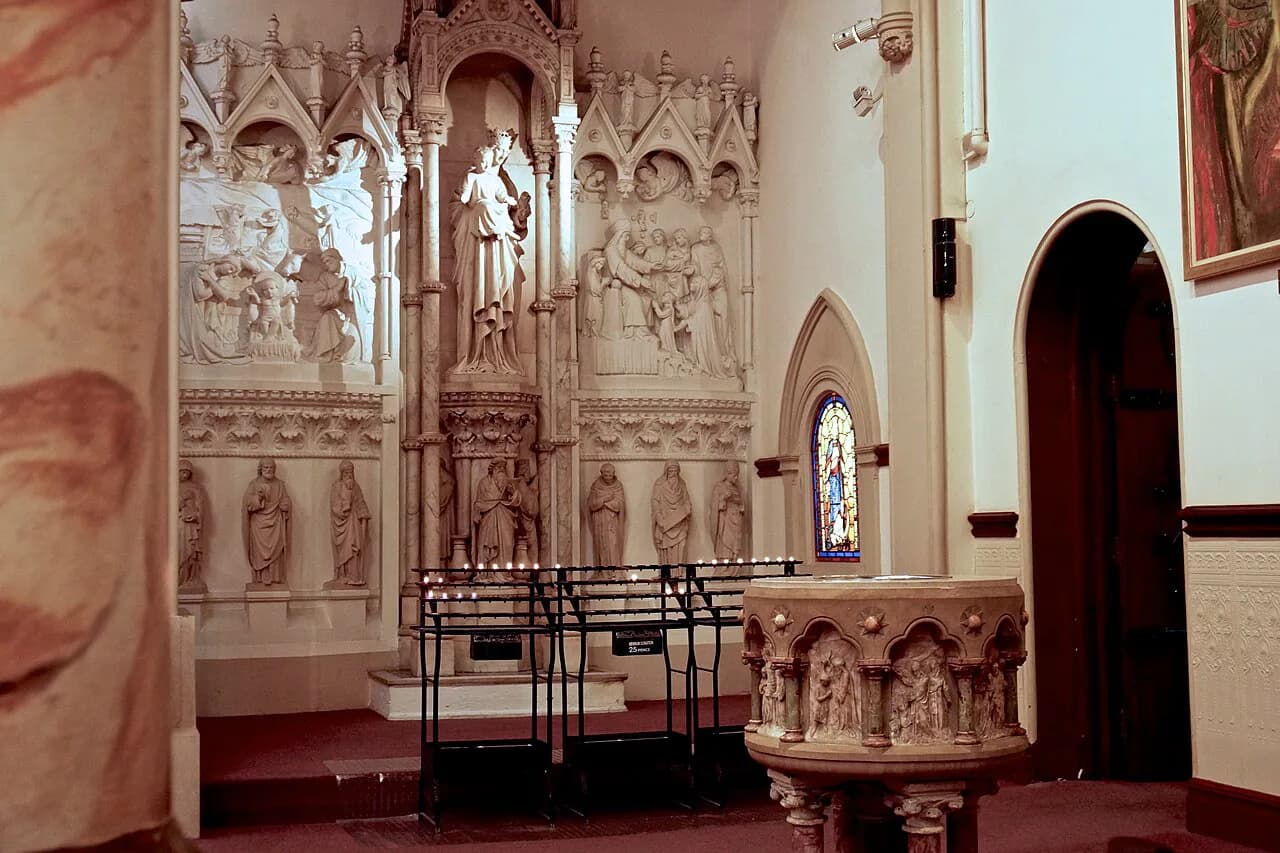
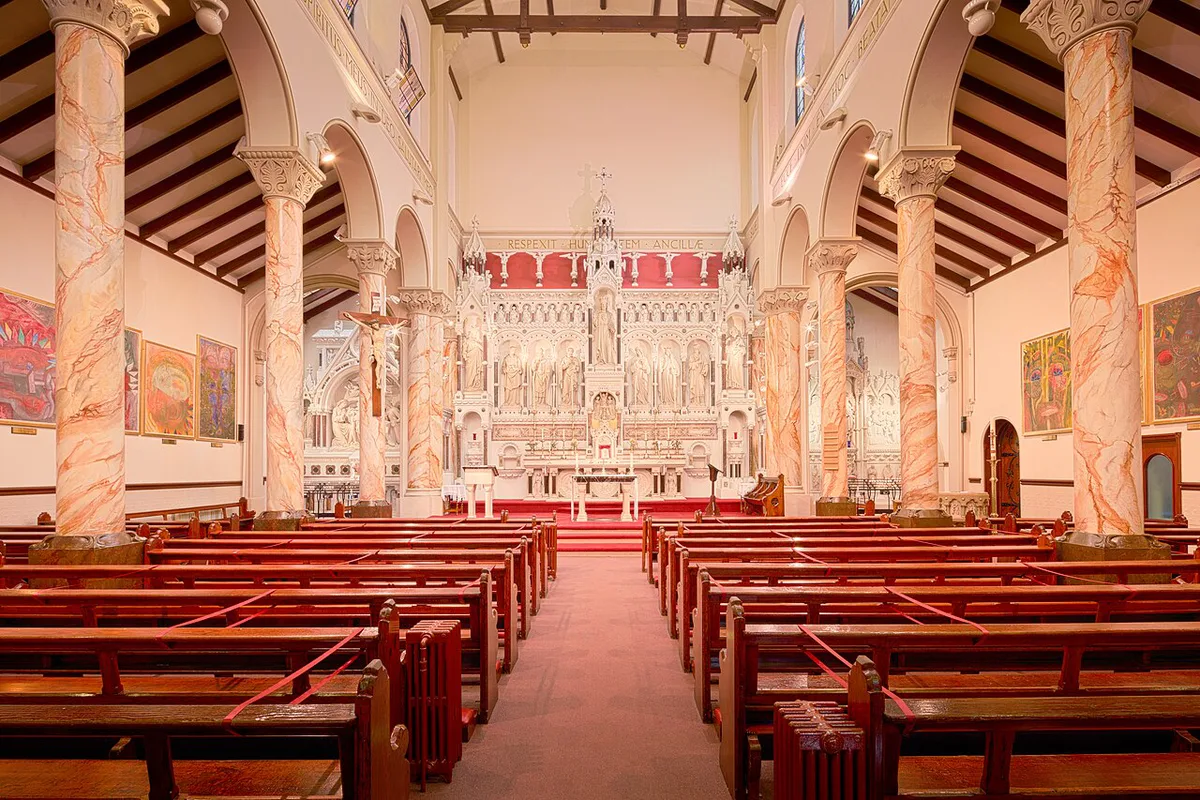
Victorian marble fixtures contrast sharply with expressionist Stations painted in 1994, creating a rare interior dialogue between centuries.
- Marble High Altar with life-size figures of Our Lady, St Patrick, St Peter, and other saints, centered on Christ and the Sacred Heart above the tabernacle
- Lady Chapel holding the Diocesan Shrine of Our Lady of Manchester
- Separate Pieta Chapel
- Carved stone doorway with Angelic Hosts and a Latin inscription
- Grade II* listing, designated 18 December 1963
The Modern Masterpiece: Norman Adams' Stations of the Cross
Norman Adams painted the church's Stations of the Cross in 1994. The series contains 14 panels, done in an expressionist style that contrasts sharply with the Victorian carving elsewhere in the building. Adams was a Royal Academician, and the commission stands out among Manchester's church art precisely because it is modern rather than Victorian or Gothic revival. Traditional Stations of the Cross in most Catholic churches use somber, realistic figures; Adams instead used vivid color blocks and abstracted forms for the same 14 scenes. Each panel uses bold color and loose brushwork instead of traditional realistic detail, which is why first-time visitors often do a double-take walking past them. The series is often described as one of the most significant modern works inside any Manchester church. Comparing the smooth marble High Altar with the raw brushwork just steps away is part of what makes a stop here worth the detour. Walk the nave slowly if the art is the main reason for visiting; the panels reward a closer look than a quick pass.
How to Find the Church: Directions from Deansgate and Albert Square
Mulberry Street sits just off Deansgate, near Peter Street and Bridgewater Hall, tucked among a block of office buildings. Deansgate is one of the principal north-south streets through Manchester's city center, lined with retail and office buildings. Use Peter Street and Bridgewater Hall as landmarks rather than relying on Deansgate alone. From Deansgate, watch for a narrow gap between two office blocks rather than a church-shaped facade. Albert Square sits a short walk from Deansgate and is anchored by Manchester Town Hall, a useful starting point for the walk to Mulberry Street. From Albert Square and the Town Hall, head toward Peter Street and Bridgewater Hall, then look for that same narrow opening. There's no spire or churchyard visible from the street, which is the entire point of the nickname. Once you spot the gap, a short approach leads directly to the carved stone doorway. A small sign and an open door are usually the only clues once the church is open for the day.
- Peter Street and Bridgewater Hall as reference points off Deansgate
- A narrow gap between two office blocks, not a visible churchfront
- No spire or churchyard facing the street
- A small sign and open door during opening hours
Mass Times, Quiet Prayer, and Opening Hours
St Mary's operates as an active parish church, not a museum, so opening hours follow the Mass schedule rather than fixed tourist hours. On weekdays, the church typically opens at 9:30am and holds Adoration of the Blessed Sacrament from 11:00am to 12:25pm. Weekday Holy Mass is at 12:30pm, after the Rosary and Benediction at noon, and the building usually closes around 4:00pm. Confession is available most weekdays and on Saturday afternoon, alongside the published Mass times. Sunday Mass is at 10:00am, with a Solemn Mass and full choir at 12 noon. Saturday adds a Vigil Mass at 5:15pm for anyone covering the Sunday obligation early. Weekday mornings before 11:00am tend to be the quietest window for viewing the Stations of the Cross without interrupting a service. Sundays suit anyone who wants to experience the Solemn Mass and choir rather than just see the building on its own. The parish publishes any changes to this schedule, including feast-day adjustments, on St Mary's official website.
| Day | Church Opens | Mass Times | Church Closes |
|---|---|---|---|
| Weekdays (Mon-Fri) | 9:30am | Holy Mass 12:30pm | Around 4:00pm |
| Sunday | 8:30am | Holy Mass 10:00am; Solemn Mass 12 noon | After Mass |
| Saturday | 9:30am | Holy Mass 12 noon; Vigil Mass 5:15pm | After evening Mass |
Etiquette, Photography, and What to Skip
St Mary's is a working parish first and a landmark second, so manage expectations before visiting. Skip it if you're after a gift shop, a cafe, or a self-guided audio tour, since none of those exist here. Visit for the art and architecture, and treat Mass, Adoration, and confession times as off-limits for sightseeing. Confession and quiet prayer periods are listed alongside Mass times, so treat those windows the same way you would an active service. General photography is fine outside of services. Skip flash and keep noise to a minimum. Avoid photos during Mass, Adoration, or confessions. Weddings or funerals in progress carry the same rule. Ask a steward if you're unsure what's happening. The Lady Chapel houses the Diocesan Shrine of Our Lady of Manchester, so keep extra distance and quiet there even outside formal prayer times. Wheelchair access isn't confirmed here, since the main doorway has a raised stone threshold and a step from street level. Contact the parish in advance to confirm the easiest way in.
- A gift shop or souvenir stall
- An on-site cafe
- A self-guided audio tour
- A typical tourist-attraction layout rather than an active parish
What's Nearby: Other Manchester Stops Worth the Detour
Pair St Mary's with a few more stops instead of treating it as a single errand. A Victorian Gothic reading room at the John Rylands Library sits further along Deansgate. Chetham's Library, one of the country's oldest public reference libraries, makes a longer detour north of the city center. Entry to St Mary's costs nothing, which puts it on lists of no-cost city center stops alongside other free museums and galleries. Afterward, several low-key bars near Deansgate make a reasonable next stop for a drink. For a quieter outdoor option instead, Manchester's small parks and garden squares offer a similar break from the main shopping streets. Independent shops and street art in the Northern Quarter's side streets cover a different part of the city center if time allows. All of these options sit within Manchester's compact city center, reachable on foot without a car. This kind of overlooked landmark isn't unique to Manchester. London hides comparable stops, covered in London's quiet churches and courtyards. Edinburgh's version of the same trail appears in Edinburgh's closes and courtyards guide. Consider building a half-day around St Mary's rather than rushing between stops.
Plan a half-day itinerary around St Mary's 10:00am Mass and nearby stops like the John Rylands Library and Chetham's Library, all reachable on foot.
Frequently Asked Questions
Why is St Mary's Catholic Church nicknamed the Hidden Gem?
Bishop Herbert Vaughan visited the parish in 1872 and praised the building from every angle he looked at it. Parishioners kept repeating his description, and it eventually became the church's common name.
Where is the entrance to St Mary's Catholic Church?
St Mary's sits at 17 Mulberry Street, Manchester, M2 6LN, just off Deansgate near Peter Street and Bridgewater Hall. Look for a narrow gap between office buildings rather than a traditional churchfront.
What time is Mass at St Mary's?
Weekday Holy Mass is at 12:30pm, after Adoration and confessions earlier that morning. Sunday Mass is at 10:00am, with a Solemn Mass and full choir at 12 noon. Saturday adds a Vigil Mass at 5:15pm for anyone covering the Sunday obligation early. Confirm exact times on the parish's current schedule before visiting, since feast days can shift them.
Is it free to visit St Mary's Catholic Church?
Yes, there's no admission fee to step inside during opening hours. Donations toward the parish's upkeep are welcome but not required from visitors.
Can visitors take photos inside the church?
General photography is fine outside of services. Skip flash and keep noise to a minimum. Avoid photos during Mass, Adoration, or confessions. Weddings or funerals in progress carry the same rule.
Is St Mary's Catholic Church accessible for wheelchair users?
Wheelchair access isn't confirmed here, since the main doorway has a raised stone threshold and a step from street level. Contact the parish in advance to check the easiest way in.
What is the church's official name and denomination?
The building is formally called St Mary's Catholic Church, dedicated to Our Lady of the Assumption. It belongs to the Roman Catholic Diocese of Salford, and almost everyone in Manchester still uses the nickname instead.