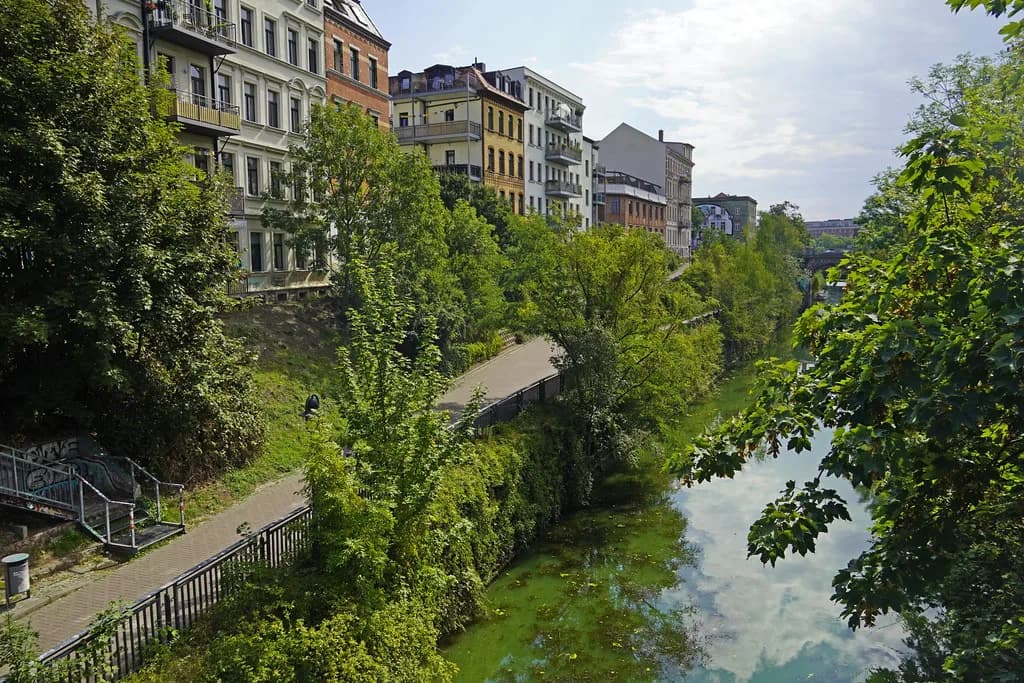
The Karl-Heine-Kanal gives Leipzig a waterside corridor that runs through the city's western districts rather than out into open lake country. According to the Leipzig tourism board, the artificial canal is 3.3 kilometres long and lies in the lively west of the city, where it supports bankside walks and boat trips alike. That combination matters for planning: you can treat the canal as a short stroll, a full linear walk, or a warm-month paddle without leaving the urban fabric of Plagwitz and Lindenau.
A practical starting split is between what is always available and what is seasonal. Leipzig Travel lists canal entrance as free, and the Visit Saxony destination page confirms the same free entrance alongside the canal's route between Lindenau harbor and the Weiße Elster. Small boats, by contrast, can navigate the waterway during the warmer months of the year, which the Saxony tourism board says can be rented at Leipzig's city harbor and numerous other locations. If your trip depends on being on the water rather than beside it, that seasonal distinction should shape when you go and what you confirm locally.
This guide is organised around three decisions: how far to walk, whether to add a boat, and how to reach the canal from public transport stops in Plagwitz and Lindenau. It keeps to what the Leipzig and Saxony tourism pages actually publish about the canal corridor, so you can plan the outing and then verify volatile details such as hire availability before you travel.
Why the Karl-Heine-Kanal Is a West-Side Waterside Walk
The canal sits in Leipzig's west rather than in the city centre or the lake district, and that location defines what kind of outing it is. Leipzig Travel places it in the lively west of Leipzig and describes walks along its banks as a special experience at any time of year. Visit Saxony locates the artificial watercourse specifically in the west of the city and in the Plagwitz/Lindenau district. Treating it as a west-side corridor rather than a day trip out of town is the single most useful framing decision you can make.
That west-side setting also means the canal pairs naturally with the industrial and creative fabric of Plagwitz and Lindenau, which you pass through rather than visit as a separate attraction. Visit Saxony notes that water travellers see former industrial architecture with artistic facades along the route. If you have already planned a broader Leipzig itinerary, fitting the canal into a western half-day keeps travel time low. A photography-focused walk along the canal can also work well, since the mix of bridges and facades gives varied subject matter; see the Leipzig photography guide for framing ideas elsewhere in the city.
The 3.3 km Course and the 15 Bridges
The canal is short by waterway standards, which is precisely what makes it easy to budget. Visit Saxony describes the artificial watercourse as connecting Lindenau harbor with the Weiße Elster across a 3.3-kilometre stretch, and adds that 15 bridges span the canal along that length. Those two figures are the backbone of any plan: they tell you the corridor is walkable end to end without committing a whole day, and that you will cross or pass under bridges frequently enough to use them as landmarks.
Leipzig Travel gives the same 3.3-kilometre length and notes that the canal was created artificially, which is why its line is so regular and its banks so consistently walkable compared with a natural river. Because the corridor runs from Lindenau harbor to the Weiße Elster, you can start at either end or dip in midway and still see a representative stretch. The bridge count also gives you a way to pace yourself: you can decide in advance to turn back after a given number of crossings rather than guessing at distance.
Walking the Banks: Free Access and How to Pace a Stroll
Walking is the most reliable way to experience the canal because it does not depend on the season or on hiring anything. Leipzig Travel lists entrance as free and says the canal invites long walks along the banks, with numerous quiet spots for a short break. Visit Saxony likewise records free entrance for the canal as a whole. If your dates are fixed and you cannot move them, the bankside walk is the part of the outing you can count on.
Pacing advice here is a suggestion rather than an official figure, because neither tourism page publishes a recommended walking time. A straightforward approach is to treat the 3.3-kilometre corridor as a linear walk and decide whether you want a one-way traverse or an out-and-back from a single access point. Using the bridges as milestones keeps the decision simple: commit to a number of bridges at the outset, then turn around when you reach it. That way the walk fits whatever time you actually have rather than an invented schedule.
Year-round appeal is one of the canal's genuine strengths, since Leipzig Travel notes that it works in summer greenery, autumn colour, ice-covered water, and spring flowers. That range means you do not need to time a visit to a narrow window merely to walk the banks. The Philippuskirche steps are a specific detail the Leipzig tourism page highlights, described as a popular summer spot for sitting by the water and taking in the canal.
Warm-Month Paddling and Where Boats Are Found
Being on the water is a warm-month activity, and the canal is explicitly navigable by small boats during that period. Visit Saxony states that the waterway can be navigated with small boats in the warmer months of the year, and that these can be rented at Leipzig's city harbour and numerous other locations. What the tourism pages do not publish is rental pricing, operator names, opening hours, or booking availability, so those details need to be confirmed directly with a rental provider before you commit to a paddling day.
The city harbour is the anchor point named in the Saxony source, which makes it a sensible first place to ask about small-boat hire even though the page does not list operators. A useful planning habit is to separate the decision to paddle from the details of who supplies the boat: choose your date based on warm weather, then verify hire locally rather than assuming a boat will be waiting. Leipzig Travel notes that a leisurely boat tour on the waterways is possible alongside the walks, which confirms the activity without adding unverifiable specifics.
Onward by Water to the Leipzig New Lake District
The canal is not a dead end on the water, which is worth knowing if you want to extend a paddle. Visit Saxony states that you can reach the Leipzig New Lake District by boat via the canal's connection to the Weiße Elster. That link is the reason the canal reads as a gateway rather than a loop, and it explains why the endpoint at the Weiße Elster matters for anyone thinking beyond the 3.3-kilometre corridor itself.
Planning an onward passage is a different exercise from a simple canal outing, because the tourism pages describe the connection but do not publish route maps, distances beyond the canal, or journey times. Treat the Weiße Elster link as the direction of travel and confirm the practicalities with a local provider if you intend to continue. For most visitors, the canal itself remains the objective, with the lake district connection as an option rather than the default plan.
What to See in Plagwitz and Lindenau Along the Way
The built environment along the canal is part of the walk, not background scenery. Visit Saxony notes that former industrial architecture with artistic facades is visible from the water, which reflects the Plagwitz and Lindenau character of the surrounding district. Leipzig Travel adds historic villas and modern industrial lofts as features of an exploration tour along the canal. Neither page covers interiors of those villas or lofts, so plan to appreciate the streetscape and facades rather than expecting access.
The canal district sits close to other west-Leipzig cultural draws, which makes it easy to combine a walk with a second stop. The Baumwollspinnerei Leipzig visitor guide is a useful companion if you want to pair the canal's industrial heritage setting with a dedicated art site in the same part of the city. Keep the combination realistic: the canal corridor is compact, so adding one substantial stop is more sensible than stringing together several.
Access and Orientation from Plagwitz and Lindenau
You do not need a single gateway to the canal, because the tourism pages list several access points instead. Leipzig Travel names three: the K.-Heine-/Gießerstraße stop on streetcar line 14, the Lindenau Bushof stop on streetcar line 15 and bus line 80, and the Elster Passage stop on streetcar line 3 and bus line 74. Visit Saxony publishes a slightly broader set, adding streetcar lines 8 and 15 and bus lines 60, 64, and 80 at Lindenau Bushof. Which stop suits you depends on which end of the corridor you want to start from.
If you arrive by car, Visit Saxony places the canal in the Plagwitz/Lindenau district and describes access via the B87 junction Zschochersche Straße, Endersstraße, or Lützner Straße. The tourism pages do not publish fares, timetables, or parking rules, so check those through the local transport operator and the city before travelling. Arriving by public transport also frees you to make the walk linear rather than a loop back to a parked car.
Choosing Between a Short Walk, a Full Canal Walk, or a Paddle
The three outing types are distinguished by duration and season rather than by route, which makes the choice fairly clean. A short walk uses one access point and a few bridges before turning back; a full canal walk covers the corridor from Lindenau harbor toward the Weiße Elster; a paddle requires warm-month conditions and a hired small boat. Only the paddle introduces an availability dependency you cannot resolve from a tourism page.
If you are building a wider Leipzig plan, the canal works as a half-day rather than a full day, leaving room for city-centre sights. A one day in Leipzig itinerary can absorb the canal as its western component, while a longer stay might place it alongside other districts on separate days. If you want to see the city more broadly before committing, the Leipzig: Landmark Visitor Guides hub collects the main visitor attractions in one place.
What to Confirm Before You Go
Anything seasonal or commercial on the canal should be verified locally rather than assumed from a guide. That includes boat hire availability and location, since the Saxony page confirms rental happens at the city harbour and elsewhere without publishing operators or hours. Water conditions and any seasonal restrictions are also not covered by the tourism sources, so ask a provider or the local tourist information before a paddling trip. Approach the canal knowing that the walking experience is documented and stable while the boating experience needs a phone call.
The distinction between free grounds and paid interiors matters here, because the canal banks are free but the district's villas and lofts are not open attractions. Neither tourism page describes interiors, so do not plan around entering them. What you can rely on is the public corridor: 3.3 kilometres of water, 15 bridges, and free access from the named transit stops. Reader reviews on the canal's TripAdvisor page offer additional perspectives on what a visit involves, though they are not an official source for facilities or prices.
Plan Your Visit
The Karl-Heine-Kanal rewards a simple plan: pick an access stop in Plagwitz or Lindenau, walk part or all of the 3.3-kilometre corridor, and use the 15 bridges to judge how far you have come. Leipzig Travel lists canal entrance as free, so the bankside outing carries no ticketing decision, only a decision about how long to stay.
Add a boat only if you are travelling in the warmer months and have confirmed hire, since the Saxony source names the city harbour and other locations without listing operators or availability. If you want a longer city context before finalising dates, a 3 days in Leipzig itinerary can help you place the canal among other neighbourhoods and attractions.
Frequently Asked Questions
How long is the Karl-Heine-Kanal and where does it run?
The canal is 3.3 kilometres long and was created artificially. It runs through western Leipzig, connecting Lindenau harbor with the Weiße Elster, and it sits in the Plagwitz and Lindenau district rather than the city centre. Along that stretch it is spanned by 15 bridges.
Can you walk the whole Karl-Heine-Kanal, and is it free?
Yes, the banks are walkable and entrance to the canal is listed as free, so no ticket is needed for a bankside outing. The tourism pages describe walks along the banks as possible at any time of year, which makes walking the most dependable way to experience the canal regardless of season.
Can you rent a boat on the Karl-Heine-Kanal?
Small boats can navigate the canal during the warmer months, and according to Saxony's tourism board they can be rented at Leipzig's city harbour and numerous other locations. Operator names, opening hours, and booking availability are not published on the tourism pages, so confirm those details directly with a rental provider before planning a paddling day.
Does the Karl-Heine-Kanal connect to the Leipzig New Lake District?
Yes, the canal connects to the Weiße Elster, and that link allows boats to reach the Leipzig New Lake District. The tourism sources describe the connection but do not publish route maps, distances beyond the canal, or journey times, so treat onward passage as an option to verify locally rather than a fixed itinerary.
How do you get to the Karl-Heine-Kanal by public transport?
Several stops serve the canal corridor. The K.-Heine-/Gießerstraße stop is on streetcar line 14, Lindenau Bushof is served by streetcar lines 8 and 15 and bus lines 60, 64, and 80, and Elster Passage is on streetcar line 3 and bus line 74. Fares, timetables, and vehicle details are not covered by the tourism pages, so check them with the local transport operator.