
Düsseldorf is a river city wrapped around a compact centre, so a photographer's biggest decision is not which landmark to visit but which direction the light is coming from. The city spreads along the Rhine with seven Rhine bridges and buildings by Frank O. Gehry and David Chipperfield, which means most of the classic views can be worked into one long day if you sequence them properly. A reasonable suggested plan for a first visit is one full day on foot in the centre plus a half day for the outer districts, though that is editorial advice rather than any official timing.
The city's two visual personalities sit a short trip apart: the brick Gothic and bar density of the Altstadt on the west bank, and the curved metal cladding of the MedienHafen to the south. Treating them as separate sessions, one in soft morning light and one in harder afternoon light, prevents the flat, contrast-blown frames that come from racing between them.
One practical planning note up front: the details that change fastest, such as admission and tours, should be confirmed with the operator rather than trusted to an old blog post. Everything below is about light, framing and sequencing, with the volatile facts left for you to check before you go.
Why Düsseldorf Rewards Light Planning Over a Shot List
A shot list tells you where to stand, but it cannot tell you whether the sun will be behind the tower or in your lens. Because Düsseldorf's headline subjects sit on a north-south river with a tower at the southern end of the centre, the same location can look like two different cities at 9am and 6pm. Building your day around the sun's arc, rather than around a checklist of photo spots, is what lets you re-shoot a location on a second visit with confidence.
Morning light favours the Altstadt's east-facing facades and the Königsallee canal, while late afternoon and blue hour belong to the Rhine promenade and the tower. Divide your time that way and you will rarely be shooting into the sun. If you only have one day, resist the urge to cover the whole city; two or three locations worked properly will beat six locations shot badly.
Rain is common enough in this part of Germany that a purely outdoor plan is risky, so keep one interior subject in reserve for each day. Cologne's counterpart guide makes the same point about German river cities: the wide river gives you cityscapes, while the narrow old-town streets give you street and candid work, and the weather decides which one you get.
How the Rhine Shapes the City's Photographic Geography
The Rhine gives Düsseldorf its north-south axis and its best long views, with the promenade running along the west bank and the tower anchoring the southern end of the centre. Because the river runs roughly north to south, the light crosses it rather than running down it, which means sunrise and sunset both come from the side. That is good news for facades near the water and bad news for anyone hoping to shoot straight down the river into colour.
The cityscape is characterized by numerous high-rise buildings, church towers and the 240-metre-high Rhine Tower, so a long lens compresses layers of architecture that a phone camera flattens into noise. Stand back on the opposite bank and you can stack a bridge, the tower and the old town into one frame. Move closer and you lose that compression entirely.
For orientation, the city's most important sights are almost all centrally located in the old town and within easy walking distance, while the Volksgarten, Kiefernstraße, Schloss Benrath and Kaiserswerth sit just outside the centre and are easier to reach by car or public transport. Use that grouping to plan transport hops rather than as a shooting order. The outer districts each need their own trip and their own light window.
Morning: Soft Light on the Altstadt and the Rhine Stairs
Early morning is when the Altstadt is genuinely quiet, and most of the old town is a car-free zone, which means you can stand in the middle of a lane without dodging traffic. The historic town hall on the market square was built between 1570 and 1573 and then underwent numerous extensions and changes, so it reads as a stack of different building phases rather than one clean facade. Shooting it early gives you even light across those phases instead of the harsh shadow lines that arrive by midday.
At Burgplatz, the round castle tower is the last remnant of the former ducal castle and now houses a maritime museum; the large Rhine stairs beside it are the natural place to sit and shoot the promenade as it wakes up. The oldest building on the square is the three-aisled Basilica of St. Lambertus, documented back to 1159 and completed in 1394.
The basilica's twisted spire is the single most recognisable silhouette in the old town, and it comes with a real story rather than just a shape. Following a fire caused by a lightning strike in 1815, the tall spire required an immediate rebuild, and the twist is generally explained by unseasoned timber that warped as it matured, a process that can last up to 50 years. A popular alternative tells of the devil twisting the steeple in a failed attempt to uproot the church altogether.
Working the Königsallee Canal: Which Bank to Stand On
The Königsallee is a tree-lined boulevard with a canal down its centre, and its two sides do completely different jobs. Shops and boutiques line the eastern side, while the quieter western side is occupied by hotels, banks and other businesses. That split is the whole photographic decision: the west bank is calmer, and standing there to look across at the tree-lined waterfront on the opposite side produces the better frame.
The canal itself is fed by the Düssel and is crossed by small bridges with wrought-iron railings, which gives you repeated foreground elements to work with. Swans and wild ducks are often on the water, so a mid-range zoom covers both the birds and the reflections without a lens change. Chestnut trees line the banks and add texture at the edges of the frame.
The boulevard was originally called Kastanienallee after those chestnut trees, and the renaming followed an 1848 incident in which protesting citizens threw objects at the Prussian king's carriage as he passed through. The story explains why the street carries a royal name today, and it is a useful line if you are captioning images of the canal for a wider audience.
MedienHafen and Neuer Zollhof: An Architecture Problem
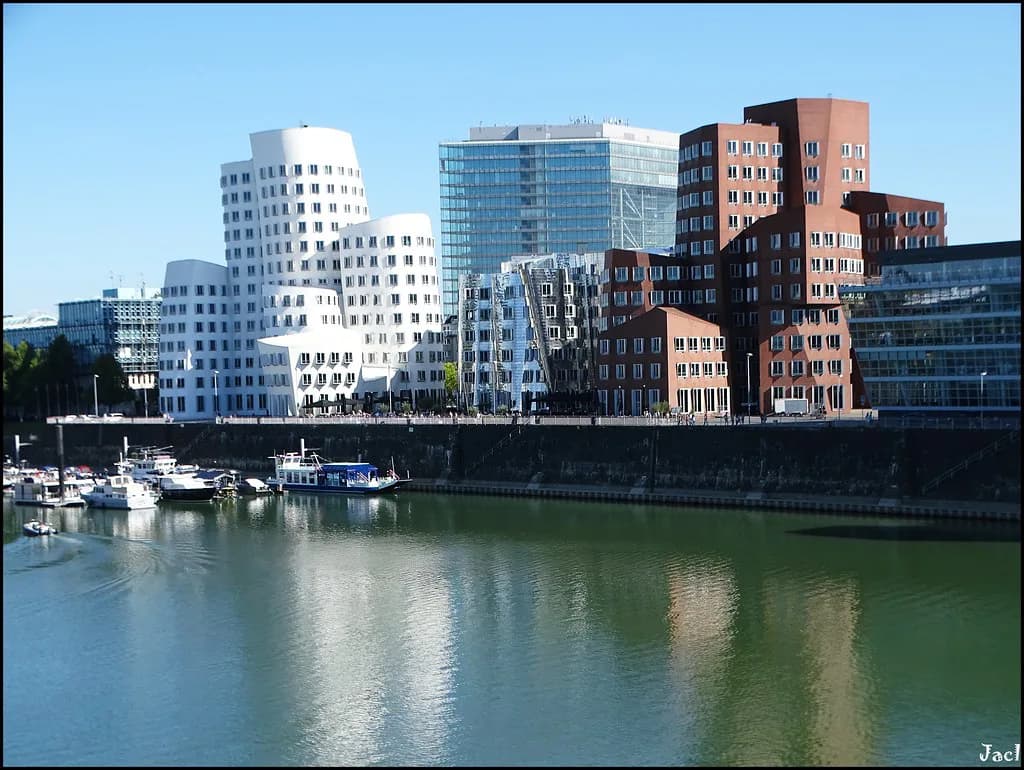
The MedienHafen is a former working harbour turned media and design district, and the transition left old tracks and quay walls sitting beside new buildings. That mix of old and new is the district's real subject, not any single facade, and it rewards wide framing over detail shots at first. Buildings by Frank Gehry, David Chipperfield, Jo Coenen, Steven Holl and Claude Vasconi all appear here, each responding to the maritime heritage in a different way.
The three-part Gehry ensemble at the Neuer Zollhof is the district's landmark, and its organically shaped, cladding-heavy forms are the hardest thing in the city to photograph well. Curved surfaces pick up specular highlights from any direction, so direct midday sun bounces off them unpredictably and blows out large areas of the frame. Overcast light, or the low sun of late afternoon, is far kinder to those shapes.
Glass is the second problem: the district's newer buildings reflect sky and neighbouring facades, so your position relative to the sun determines whether you get a mirror or a murky slab. Walk the block once with your eyes on the reflections before committing to a tripod position. If you only have harsh midday light, shoot tight abstractions of the cladding and save the wide establishing frames for later.
Afternoon and Blue Hour on the Rhine Promenade
The promenade is the city's living room, with excursion boats docking, people sitting on the walls and deck chairs appearing in fine weather. Walking along the banks in the afternoon, you can also discover sights such as the Tonhalle or the Ehrenhof at the Kunstpalast, which sit only a few metres from the water, so a single stroll covers several subjects. Because the promenade faces across the river rather than into the sunset, the good light arrives from the side, which keeps both banks readable.
Blue hour is the payoff: the Rhine Tower's shaft carries the Lichtzeitpegel light sculpture, with 39 porthole lamps arranged in three height sections so the beams produce the largest decimal clock in the world. Pair it with a bridge in the same frame to give the composition depth. Bridges at night also give you reflected light on the water, which fills the darker half of the image.
Reviews describe cocktails at the tower bar and a Japanese-European rotating restaurant above it, but restaurant service is exactly the kind of detail that changes, so check the tower's own pages before you plan an evening around it. Treat any past visitor account as evidence that something happened once, not proof of what happens today.
Elevated and Long-Lens Options at the Rheinturm
The Rheinturm observation deck gives you the one thing no riverside position can: a top-down reading of the city's structure, with the harbour, the parliament buildings and the river bends all visible at once. It sits at the southern end of the centre next to the MedienHafen, which makes it a natural finish to a harbour session. Clear weather is the whole point of the trip up, so check the forecast rather than the calendar. For wider planning, see Rheinturm Düsseldorf Visitor Guide.
A telephoto or mid-range zoom matters more up here than a wide lens, because distance compresses the city into dense layers that only a longer focal length can separate. Pick out the harbour's curved buildings, the bridges and the tower's own shadow across the water instead of trying to capture the whole panorama in one frame. Window glass adds its own reflections, so press close and shade the lens.
Admission, elevator access and any combination with dining are commercial arrangements the operator revises, and travellers report different options at different times. Do not build a plan around a specific ticket inclusion; confirm current access, booking practice and whether the restaurant is serving directly with the tower.
Beyond the Centre: Kaiserswerth and Schloss Benrath
Kaiserswerth, in the north of the city, is one of Düsseldorf's oldest districts, with Baroque-era houses from the 17th and 18th centuries along its main street and the twelfth-century Kaiserpfalz ruins, the royal palace of Emperor Friedrich Barbarossa, enclosed by a stone wall near the Rhine. The basilica of St. Suitbertus also calls Kaiserswerth its home, a Romanesque church that incorporates a shrine with gilded decoration.
This is a morning location rather than an afternoon one. Arriving around ten gives you the main street and the riverside path close to empty, whereas the neighbourhood fills up noticeably by lunchtime. Pair the ruins with the Rhine-side walk and the Romanesque basilica for a compact set of architectural subjects in soft, low-contrast light.
Schloss Benrath, in the southern Benrath district, is a Rococo palace with early Neoclassical elements set in an extensive park, and it has functioned as a museum since 1929. The gardens are free to walk and stretch towards the Rhine, with formal sections giving way to a landscaped English garden, an orangery and a working kitchen garden. The palace, the Museum of European Garden Art in the east wing and the Museum of Natural History in the west wing are separate ticketed interiors rather than one combined visit.
Palace Interiors: The Practical Constraints Behind the Camera
The palace rooms are generally seen on guided tours at set times rather than at your own pace, which immediately changes how you shoot. Flash photography is not allowed inside and high heels are prohibited in the interiors, so plan for available light and check footwear before you arrive. Expect to work at higher ISO with a fast prime rather than with a tripod and a long exposure.
Opening days vary between the palace, the two wing museums and the park, and schedules are not fixed across the complex, so treat any single source's times as a starting point rather than a rule. The official palace website is the only reliable place to confirm times and tour slots before you travel. If you are travelling for photography specifically, a rainy day is a good moment to spend on interiors you would otherwise skip.
Compositionally, the interiors reward symmetry and patience rather than gear. A particular highlight is the magnificent stucco work created by the Italian plaster master Giuseppe Antonio Albuccio, which gives strong relief that reads well in gentle light. Frame down the axis of a room to use that symmetry, then move off-centre for detail frames of the floors and ceilings.
Details Worth a Deliberate Stop: Street Art and Public Art
Kiefernstraße in Flingern-Süd carries murals across house facades over a length of more than 200 metres, painted in the 1980s when the street became known for its left-alternative squatter scene. The scale is the point: you need distance and a slightly long lens to compress the murals without distortion, and early light keeps the colour saturated. This is a residential street, so shoot from the public pavement and keep voices down.
The Zeitfeld art installation near the western entrance of the Volksgarten consists of 24 station clocks on six-metre-high columns, all set to the same time and facing the same direction. It dates from the Federal Garden Show in 1987 and sits inside the larger Südpark, so it pairs naturally with a walk. Repetition is the subject here, and a straight-on composition from ground level works better than a downward angle.
The advertising columns topped with bronze figures, known locally as pillar saints, are another recurring detail in the centre; the project has placed figures modelled on everyday people above ordinary street furniture since 2001. Pillar saints are easy to overlook on a route march between big landmarks. Slow the walk through the Altstadt by twenty minutes and you will find several.
Gear, Settings and Etiquette: Tripods and Photographing People
Outdoors, a light tripod is genuinely useful for blue hour and for the wall-mounted viewpoints along the promenade, where you can brace against stonework instead of setting up in the path of walkers. Indoors, tripods are the wrong tool: palaces, churches and museums restrict them, and low light there is better handled by pushing ISO and opening the aperture. A polariser earns its place on the Königsallee canal and the harbour glass, where it cuts reflections you may or may not want to keep.
For settings, prioritise a shutter speed fast enough to freeze people on the promenade, then let aperture and ISO follow. The Altstadt's lanes are narrow enough that a 35mm or 50mm equivalent frames a facade without stepping into the road, while the river and the tower want at least a modest telephoto for compression. Exposure bracketing helps on bright days when pale facades sit beside deep shadows.
On people: churches, markets and lanes are working spaces, so ask before you make a portrait and put the camera down if the answer is no. The Altstadt and the Carlsplatz market are busy social settings rather than photo studios. In churches, restrict yourself to available light and respect any signage that restricts photography in specific areas.
Weather, Season and the Crowd-Light Trade-Off
Visitors cluster in the warmer months, and broad seasonal overviews note that most visitors come between April and October, when daily temperatures are 60 degrees Fahrenheit or above, although there is a stream of tourism to the city year round. The trade-off is straightforward: the best light of the year often coincides with the most people in the frame. If you want the Altstadt empty, the shoulder seasons and early weekday mornings are when you get it.
Changeable weather is the local norm, so carry rain protection for the camera and keep one flexible indoor option in reserve for each day. Overcast light is not a write-off: it is the best possible light for the MedienHafen's curves and for interior detail work. Sunshine is best spent on the river and on wide cityscape frames.
In winter, the light window is short and the city shifts indoors, so plan fewer locations with longer dwell times rather than a long route. Cold also shortens battery life, so carry a spare and keep it inside a coat pocket. If you time a trip around a seasonal market, confirm the dates and hours with the organiser rather than relying on a blog post from a previous year.
Three Mistakes Photographers Make in Düsseldorf
The first is trying to shoot everything from one bank of the Rhine. The city's best-known composition is assembled from the side opposite your subject, and the Königsallee is the clearest example: the west bank gives you the view across the canal rather than the shopfronts. Crossing the water is part of the job, not a detour.
The second is arriving at the MedienHafen at midday and blaming the architecture. The curved cladding and the glass are actively hostile to harsh overhead sun, and a two-hour shift in timing can rescue an otherwise unworkable frame. Build the harbour into late afternoon and spend midday on interiors instead.
The third is treating one ticket as cover for a whole complex. At Benrath, the palace interiors and the two wing museums are ticketed separately from the free park, and at the tower, access and dining arrangements are commercial decisions that change. Confirm what each ticket includes at the source rather than assuming a site-wide pass.
Plan Your Düsseldorf Photo Walk
Sequence the city by light: mornings in the Altstadt and along the Königsallee canal, afternoons in the MedienHafen, and blue hour on the Rhine promenade with the tower in frame. Save one morning for Kaiserswerth before the neighbourhood fills and one half day for Benrath's free park, with the palace interiors kept as a wet-weather alternative.
Before you travel, confirm anything that can change: access and tour times at the tower, the palace and its wing museums, and any current restrictions on tripods or flash indoors. City tourism pages and the operator's own site are the right places to check, since third-party write-ups age quickly on exactly these points.
Build the rest of the trip around that shooting plan with the Düsseldorf: Landmark Visitor Guides collection, which covers individual sites in more depth, and the city itineraries for the wider route, including the one day in Düsseldorf itinerary and the 3 days in Düsseldorf itinerary that connect the centre with the Rhine valley.
Frequently Asked Questions
What are the best photography spots in Düsseldorf for a first visit?
Start with the Altstadt and the Rhine stairs at Burgplatz for the historic core and the twisted spire of St. Lambertus, then move to the Königsallee canal for tree-lined reflections. The MedienHafen delivers the city's most distinctive modern architecture, and the Rhine promenade with the Rhine Tower in the distance is the classic late-day view. If you have a second day, add Kaiserswerth in the north and Benrath in the south.
What time of day is best for photographing the Rhine promenade in Düsseldorf?
Late afternoon through blue hour works best, because the promenade faces across the river rather than into the sunset and the tower's light sculpture stays legible as the sky darkens. Pair a bridge with the tower in the same frame to give the composition depth and to catch reflected light on the water. Midday is workable but produces flatter, harder contrast.
Can you take photos inside Düsseldorf's museums and palaces?
Outdoor subjects such as the Rhine promenade, the Königsallee canal, the MedienHafen facades, the Kaiserpfalz ruins and the Benrath park are open and don't need permission. Interiors are more restricted: at Schloss Benrath, rooms are generally seen on guided tours, flash photography is not allowed and high heels are prohibited. Confirm current rules with each venue before you visit, since policies change.
Is the Rheinturm worth visiting for photography?
Yes, if you want a structural overview of the city rather than another street-level frame. The observation deck sits high above the harbour, the parliament buildings and the river bends, and clear weather is essential for the long sightlines. Bring a telephoto or mid-range zoom rather than a wide lens, since the value up there is in compressing distant layers. Check current access and booking practice with the operator.
Where can you photograph street art in Düsseldorf?
Kiefernstraße in Flingern-Süd is the main concentration, with murals running along house facades over more than 200 metres, painted from the 1980s onwards. It is a residential street, so shoot from the public pavement and keep noise down. The Zeitfeld installation near the Volksgarten and the pillar saints on advertising columns in the centre are other deliberate detail stops that are easy to miss on a fast route.
Do you need a tripod for photographing Düsseldorf?
A light tripod helps outdoors at blue hour and at wall-mounted viewpoints where you can brace against stonework, but it is the wrong tool indoors. Palaces, churches and museums restrict tripods, and low-light interiors are better handled by raising ISO and opening the aperture. A polariser is often more useful than a tripod along the Königsallee canal, where it controls unwanted reflections.
Sources
- Düsseldorf Travel Guide | Düsseldorf Tourism - KAYAK
- Düsseldorf - Sights & the most beautiful photo spots
- [2026 Dusseldorf Attraction] Konigsallee Travel Guide & Travel Experiences | Updated Oct | Trip Moments
- Dusseldorf Rhine Tower (Rheinturm) - Flyctory.com
- Why is the St. Lambertus Church Tower Twisted? Pretty Curious, Right? - Life in Düsseldorf: Expat Guide & Family Fun
- Benrath Palace Guide: History, Gardens & Tickets | Dusseldorf
- Are You Traveling To Germany? Here Is A Photographer's Guide To Cologne | Light Stalking


