
Oper Leipzig is not one building. The company performs in two venues in different parts of the city: the Opera House at Augustusplatz 12 and the Musikalische Komödie at Dreilindenstraße 30. That single operational fact should decide how you plan your evening before you look at any production.
The two addresses sit in different quarters and suit different evenings. Picking the wrong one means a cross-city dash rather than a relaxed pre-theatre drink, so treat the venue as your first booking decision and the repertoire as your second.
This guide explains which house stages what, how to read the season programme, what the 1960 Opera House building is like inside, and how the ticket-as-travel-pass rule works. It also sets out plainly which details, such as seat categories, standing room and house rules, you must confirm directly with the ticket hotline rather than assume.
Oper Leipzig: Two Houses, One Company
The company describes its purpose as operating a music theatre whose main genres are opera, operetta, musical and ballet, staged at the Opera House and the Musikalische Komödie. Both venues are listed on the organiser's own contact block, which is the simplest way to confirm which address applies to your chosen date. Oper Leipzig is city-owned and also runs theatre and costume workshops that serve other Leipzig stages.
The practical consequence is that a single programme listing can point to either building. Musikalische Komödie evenings appear alongside main-house opera in the same overview, labelled by venue, so the genre split is your fastest clue about which address you are booking.
If you are building a wider musical weekend in the city, this opera house is one of several venues worth weighing. The Gewandhaus Leipzig visitor guide covers the concert hall, its orchestra and its own programme rhythm, and comparing the two helps you decide where a single free evening is best spent.
The Two Addresses: Augustusplatz and Dreilindenstraße
The Opera House, or Opernhaus, stands at Augustusplatz 12, on the eastern edge of the city centre where the square opens toward the main station. The Musikalische Komödie is at Dreilindenstraße 30 in the western part of Leipzig, a residential district rather than the innermost core. Treating these as one destination is the most common planning error.
Because the addresses are published openly, you can settle your route before buying anything. A useful habit is to note the venue code printed beside each date in the season overview, then check the corresponding address once, rather than re-reading it for every performance you consider.
The city-centre location of the Opera House makes it simple to pair an evening there with dinner or a walk through the surrounding streets. The Musikalische Komödie, being further out, rewards a more deliberate plan: decide your onward route before the performance rather than after the final curtain.
How to Choose Between the Houses
Oper Leipzig's stated genres divide fairly cleanly: grand opera and ballet dominate the Opera House, while operetta and musical sit with the Musikalische Komödie. Recent programme entries illustrate the pattern, with Tchaikovsky's Eugen Onegin and Puccini's La Bohème listed at the Opera House and Johann Strauss's Die Fledermaus listed at the Musikalische Komödie.
Choose the Opera House when the work itself is the reason for the trip. Choose the Musikalische Komödie when you want a lighter evening and are willing to travel a little further for it. Neither is the default, and the price of getting it wrong is simply logistics.
Families and first-time opera-goers often find the Musikalische Komödie repertoire more approachable, since operetta and musical carry spoken dialogue and familiar melodies. That is a generalisation about genre rather than a statement about any specific production, so weigh the individual work, not just the house.
If your evening is part of a broader itinerary, it is worth slotting the performance into a plan rather than treating it as a standalone booking. Leipzig itineraries and city travel guides show how a theatre night sits alongside the city's other landmarks and districts.
Reading the Season Programme
The programme, or Spielplan, is organised as a single calendar in which each entry carries a production title, a date, a start time and a venue. Oper and Musikalische Komödie performances interleave across the month rather than occupying separate pages, so the venue column is not decoration. It is the field you must read first.
Premieres and revivals are flagged separately from regular performances, and the programme also lists items beyond the main stages, including offerings aimed at younger audiences. Do not assume every entry is an evening-length work in the main auditorium, because the same listing page mixes formats and rooms.
Titles rotate as the season progresses, so a production you read about months ago may not be on stage during your visit. Check the live calendar close to your travel dates rather than relying on a saved screenshot or a third-party summary.
Inside the 1960 Opera House
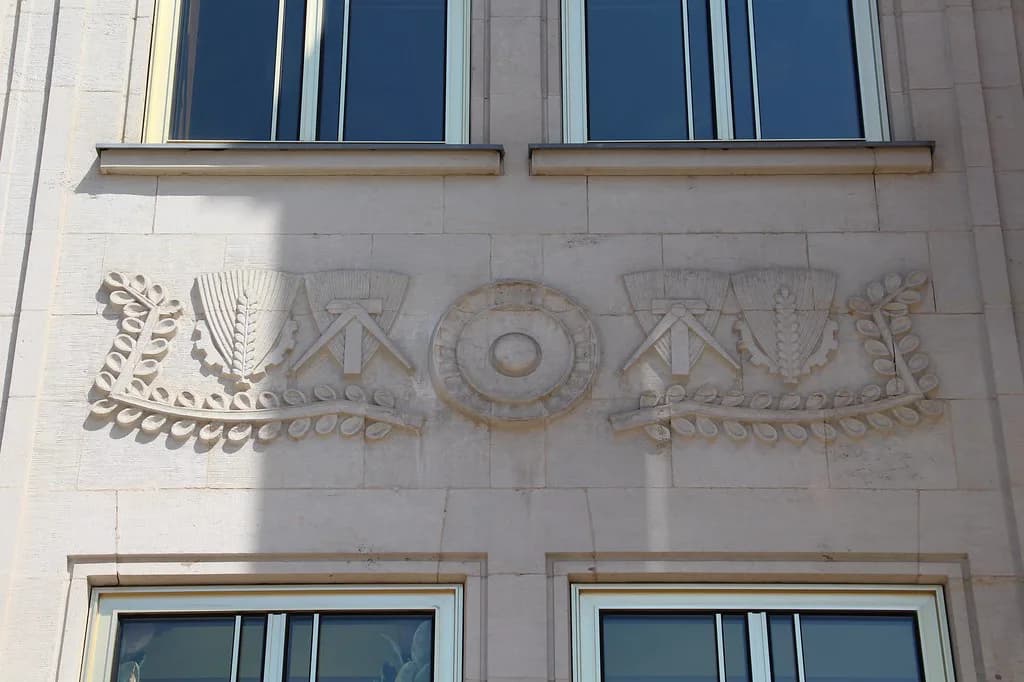
The present Opera House on Augustusplatz opened in 1960 and is a listed building, built by architects Kunz Nierade and Kurt Hemmerling after they were commissioned in 1954. Its facade uses bright Pirna sandstone, and its stepped, glass-fronted mass reads sober by day and considerably more festive when lit at night. It remains a coherent example of late-1950s theatre architecture rather than a historic opera interior.
The auditorium is a single-tier form, described as trapezoidal, seating 1,273 people. For a visitor this matters as orientation rather than as a tip: a single raked tier of this size means the relationship between stage and audience is more compact than in a multi-tier horseshoe house.
The foyers are unusually generous for the period, reached via a vestibule and a double-flighted main stair, with materials including stone flooring, handcrafted tile and brass stair railings. The interior palette is dominated by white, gold and maroon, which is why arriving early to look around the foyers is worthwhile in its own right.
For contrast in the same city, the City-Hochhaus Leipzig visitor guide covers a very different piece of architecture and a different kind of view over the centre, useful if you want one building-based stop alongside the theatre.
A Suggested Evening Timeline
The following is our suggestion, not official guidance. Work backwards from the start time shown on your chosen date in the Spielplan, and let the printed time, not a remembered one, set the plan.
Allow roughly 45 to 60 minutes at the venue before curtain if you want to collect tickets, find your seat and see the foyers without rushing. The Opera House's open stair and foyer sequence rewards a few unhurried minutes, and a cushion of time protects you if your transport is delayed.
Add your travel time on top, and check it against the theatre's own transport note rather than a static map estimate. Because a marked ticket covers defined transport around the performance, arriving early is usually more comfortable than arriving exactly on time.
Build in a buffer after the performance as well, particularly for a Musikalische Komödie evening outside the centre. If you want to extend the night, things to do in Leipzig at night lists options once the curtain falls and gives you somewhere to go instead of idling at the stop.
The Ticket-as-Travel-Pass Rule
Oper Leipzig states that its tickets count as travel passes for all Mitteldeutscher Verkehrsverbund (MDV) services, including bus, tram, S-Bahn and regional trains, within Zone 110. The window runs from three hours before the performance to three hours after it. That turns your theatre ticket into a return journey across central Leipzig.
The condition matters, and it is easy to miss. The benefit applies only when the corresponding marking is printed on the ticket itself, so a booking confirmation on your phone is not automatically the same thing. Check the wording on the ticket you actually hold before you board.
Zone 110 is the central MDV zone, not the entire network, so the pass does not cover every journey you might make that day. It is best treated as a bonus on your theatre evening rather than as a general city transport solution.
If your plans take you well beyond the centre, buy a separate ticket for those legs instead of stretching this one. Stations and stops sit within easy reach of Augustusplatz, which makes the rule genuinely useful for a central evening.
What You Must Confirm Before Booking
Ticket categories, seat-group pricing, standing room and its availability, box-office hours, booking and exchange conditions, dress code, cloakroom arrangements, late entry and photography rules are all details that change or that depend on the specific production. None of them can be taken from a general guide, including this one.
The reliable route is the organiser's own site and its ticket hotline, published as +49 (0)341 12 61 261, together with the two venue addresses. Ask about the exact date you intend to attend, because conditions can differ between the Opera House and the Musikalische Komödie.
One misconception worth clearing up: a single ticket does not grant access to both houses. Each venue is ticketed separately, so the address on your ticket, not the company name, determines where you go.
Plan Your Visit
Start with the venue, not the title. Confirm whether your date sits at Augustusplatz 12 or Dreilindenstraße 30, then check the live Spielplan for the start time, and only then think about the surrounding evening.
Treat the ticket-as-travel-pass rule as a useful extra rather than a plan: it covers MDV Zone 110 from three hours before to three hours after the performance, and only when the marking is printed on your ticket. For everything else, from seat categories to standing room and house rules, call the ticket hotline and get the answer for your own date.
Frequently Asked Questions
What is the difference between the Opernhaus and the Musikalische Komödie?
They are two separate venues run by the same company at two different addresses. The Opera House at Augustusplatz 12 stages main-house opera and ballet, while the Musikalische Komödie at Dreilindenstraße 30 stages operetta and musical. The season programme marks the venue beside each date, so read that column before booking anything.
Where is Oper Leipzig located in the city?
Oper Leipzig performs at the Opera House on Augustusplatz in the city centre, close to the eastern side of the square, and at the Musikalische Komödie on Dreilindenstraße in the western part of Leipzig. The two addresses are not within walking distance of each other for most visitors, so check which one your ticket names before you plan your route.
Does my Oper Leipzig ticket include public transport?
According to Oper Leipzig, a ticket counts as a travel pass on MDV services within Zone 110, covering bus, tram, S-Bahn and regional trains from three hours before the performance until three hours after it. The benefit applies only when the corresponding marking is printed on the ticket, so check your actual ticket rather than a confirmation email.
How big is the auditorium at the Leipzig Opera House?
The Opera House auditorium, opened in 1960, is described as a trapezoidal single-tier house with 1,273 seats. Treat this as orientation information about scale and sightlines rather than as guidance about which seats are best, since seat categories and their availability need to be confirmed with the venue itself.
How do I confirm seat categories, standing room and house rules?
Contact the ticket hotline listed on the Oper Leipzig website and ask about your specific date and venue. Prices, seat groups, standing room, booking and exchange terms, cloakroom arrangements, late entry, photography and accessibility provisions all depend on the production and the house, and none of them should be assumed from a general guide.


